From a removable denture to a fixed bridge — Mr. Sajid's upgrade.
Mr. Sajid is a 35-year-old mechanical engineer who came to our Engineers Town clinic with a clear, work-driven complaint — the removable denture he had been wearing for years had become incompatible with his professional life. This is the case file for the conversion to a fixed anterior PFM bridge that gave him stability, comfort and a smile he never had to take out again, across five visits in five weeks.
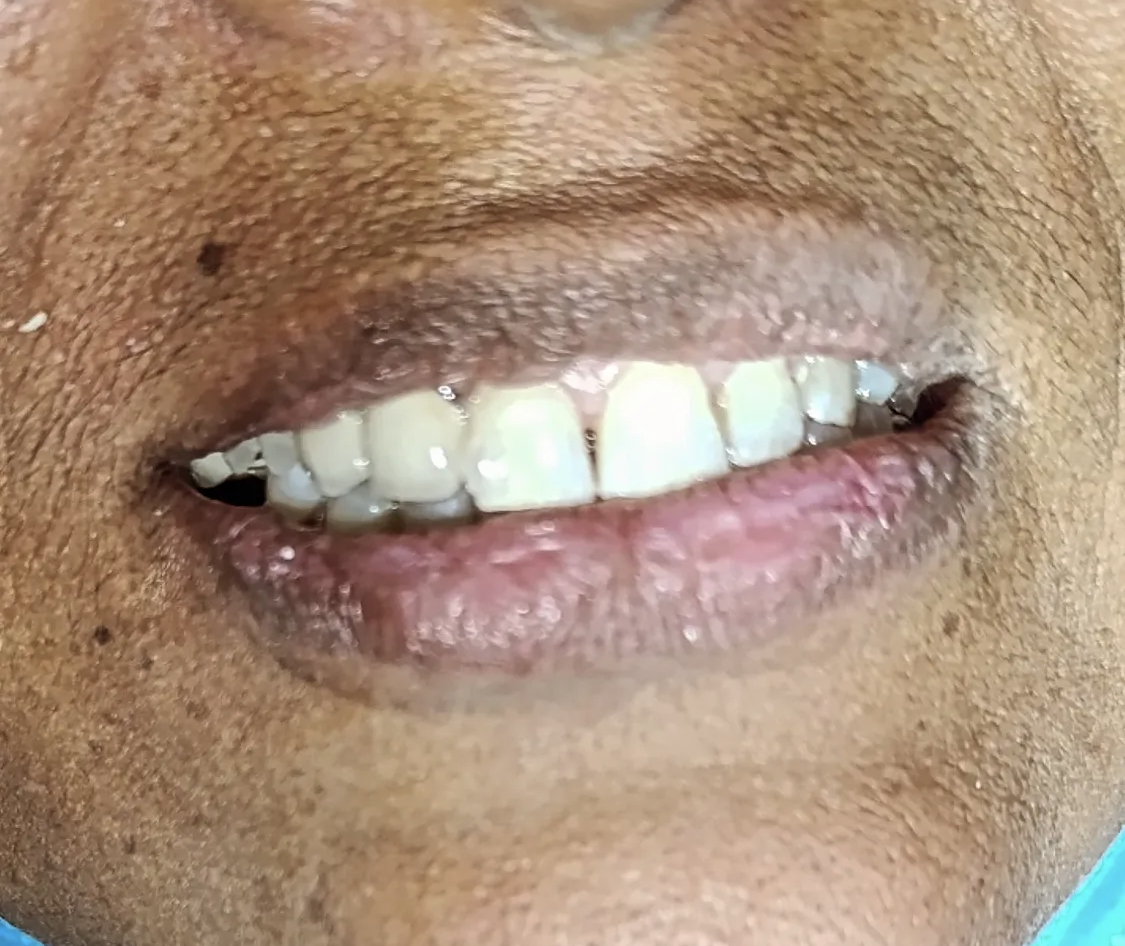
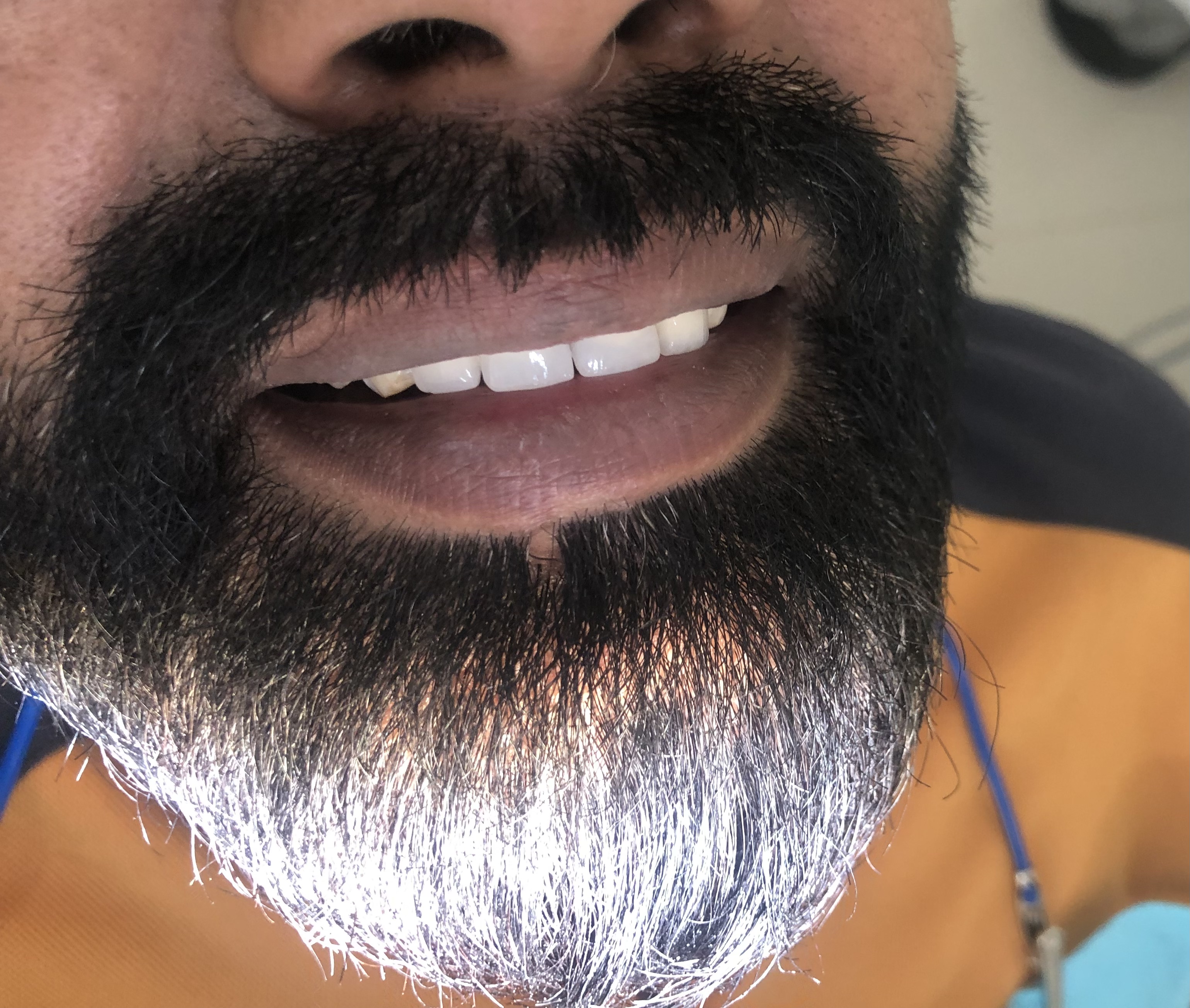 Before
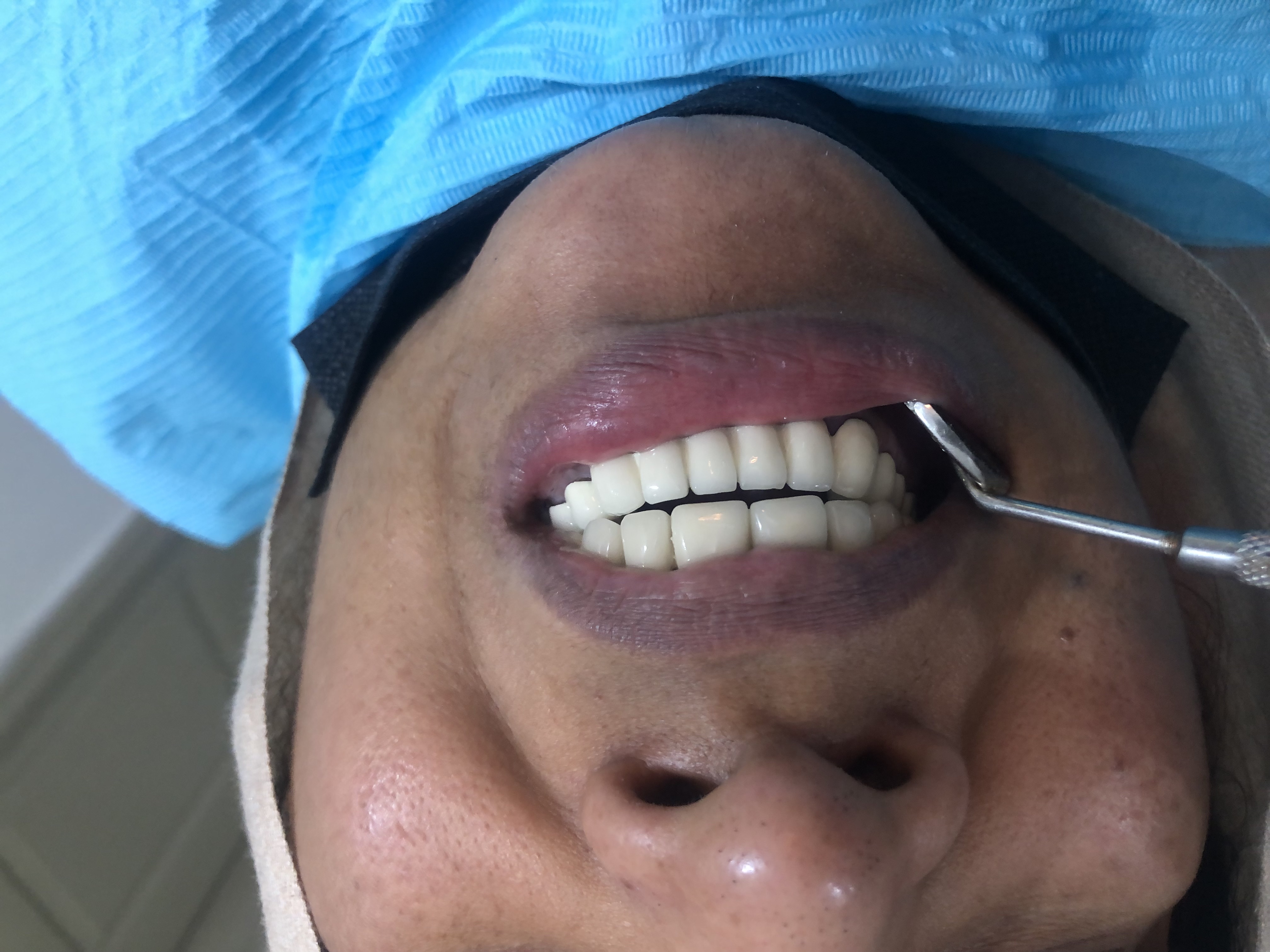
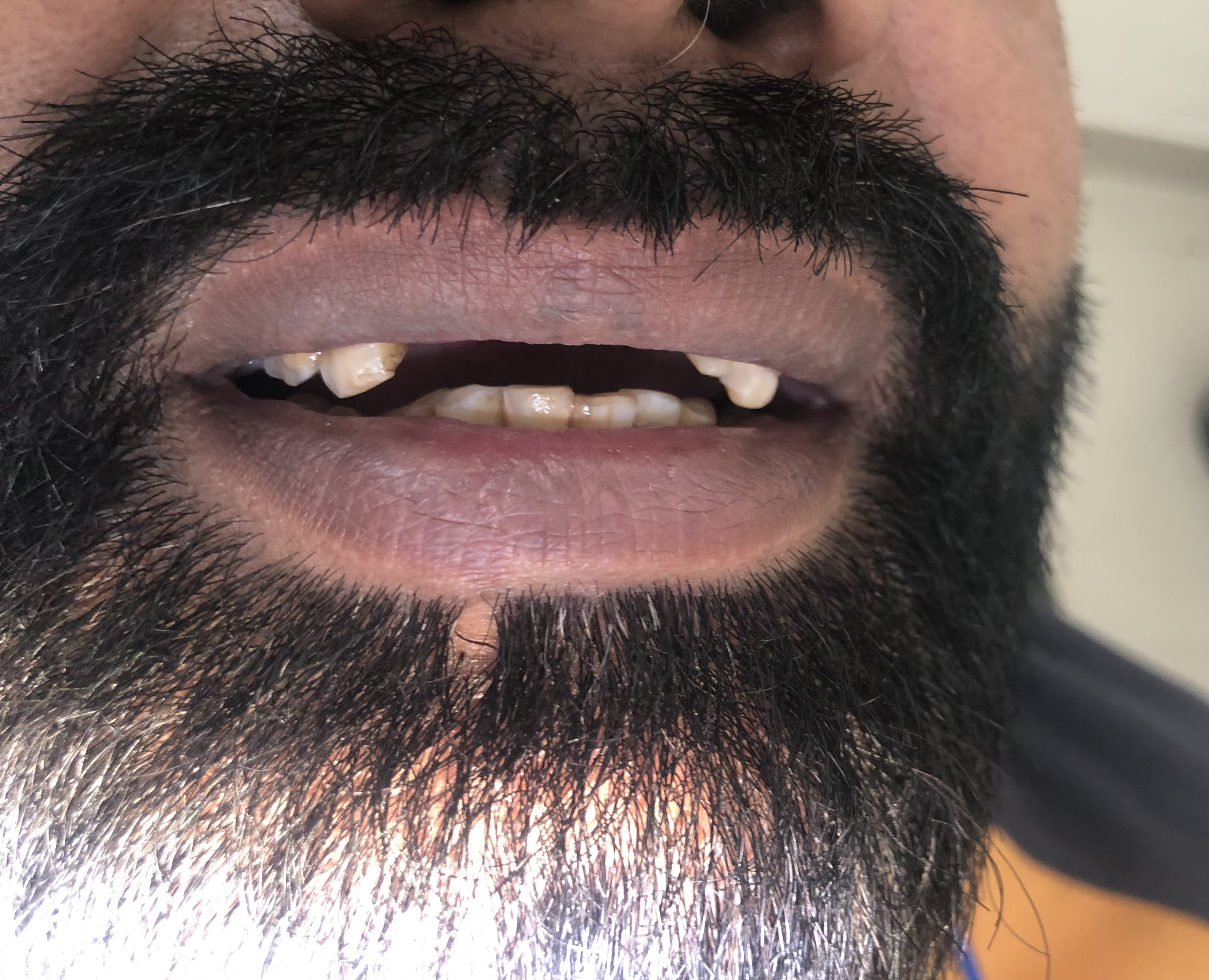 After
AfterA working professional who needed his teeth to be just teeth.
For a patient whose work involves constant detailed interaction — meetings, on-site supervision, client presentations — a removable denture is not just a dental appliance. It is a daily mental load. Mr. Sajid's case is a study in how the right solution depends on the patient's actual life, not just the textbook.
Mr. Sajid came in to our clinic on a Saturday morning, having booked the appointment a week earlier. He is roughly 35 years old, a mechanical engineer working on a manufacturing project at the edge of the city, and a polite, deliberate patient who answered questions concisely. His chief complaint was direct: “The denture I have doesn't fit, and I'm tired of taking it out.”
The denture in question was an acrylic removable partial that replaced two upper anterior teeth. He had been wearing it for several years. The original teeth had been lost — he explained — to a combination of trauma in his late twenties followed by a complicated extraction at a different clinic. He had been fitted with the removable denture immediately afterwards and had not revisited the question of long-term replacement since.
The denture had three problems by the time he came to see us. The fit had loosened — there was visible movement when he spoke. The clasps that engaged his canines had caused mild wear at the contact points. And, most importantly for his daily life, he had developed a habit of removing the denture for any kind of detailed work or important conversation. As an engineer running a project on a noisy factory floor, having to remove a dental appliance before a supervisor briefing had become impractical and embarrassing.
The clinical examination took 50 minutes. We charted the four potential abutment teeth — both upper lateral incisors and both upper canines — and found them all in good condition. No decay, no large restorations, no periodontal pocketing greater than 3 mm. The panoramic radiograph confirmed adequate alveolar bone around all four abutments. The case was straightforward from a clinical standpoint.
We presented two options. Option one was implants — two implants placed in the missing-tooth sites, with a CBCT scan first to confirm bone volume after years of removable-denture wear, a 4 to 6 month osseointegration period, and crown loading at the end. Option two was an anterior PFM bridge — preparation of all four abutments, a chair-side acrylic provisional from the day of preparation, and the final bridge cemented within five weeks. We wrote both quotes, gave him both, and asked him to take four days to decide.
He came back on the morning of the fifth day. The decision was the bridge, and his stated reasons were practical — timeline, cost, and a clear preference for avoiding any additional surgical procedure. Treatment started the following week. By the end of the second visit, the old removable denture had been retired permanently and he was wearing a chair-side acrylic provisional that looked, to a casual observer, exactly like his own teeth.
By the end of the fifth visit, the final glazed PFM bridge was cemented, the bite was balanced, and he had a smile that did not require him to take anything out of his mouth ever again.
Worth noting more carefully is the photographic documentation we maintained throughout the case. At the consultation visit we took six standardised intra-oral photographs both with and without the existing removable denture in place. This allowed us to plan the new bridge to a shape independent of how the old denture had been positioning the lip. The photographs also gave Mr. Sajid a clear baseline against which he could later see the change — patients who have lived with a removable denture for years sometimes lose track of how their natural smile looked before treatment began, and the comparison set anchored the conversation about aesthetics throughout the case. At every try-in stage, photographs were taken under the same lighting and at the same angle so the patient could see the progression toward the final result.
There is one detail of the case worth describing in more depth because it matters for any patient considering the same conversion. The first 48 hours after the cementation of a fixed bridge in a patient who has worn a removable denture for years is a period of unusual psychological adjustment. The patient's mouth has been habituated for years to a sensation of an appliance sitting on the palate and gum, and the absence of that sensation can feel oddly unfamiliar at first. Mr. Sajid messaged us at the end of the first evening to confirm that he had been touching the new bridge with his tongue repeatedly throughout the day, half-expecting it to come loose. That is normal. After 72 hours the brain has fully recalibrated and the patient stops noticing the new restoration the way they had stopped noticing the old denture — except that the new restoration does not need to be removed at any point.
The second detail worth noting is the way the bite settled across the first two weeks. A fixed bridge transmits chewing forces directly through the abutment teeth into the bone, which is a different load pattern from a removable denture that distributes force across the gum. Mr. Sajid's lower posterior teeth — which had been carrying disproportionate load for years while his upper front teeth were on a removable appliance — slowly recalibrated as the new bridge took on its share of the chewing work. By the four-week mark, he reported that his lower teeth felt “less tired” at the end of the day. That is the kind of qualitative change that does not show up on any X-ray but matters enormously to the patient's daily life.
Finally, there is the long-term plan. A four-unit PFM bridge in a patient like Mr. Sajid — healthy adult abutments, no diabetes, no smoking history, no parafunctional habits — has a realistic published service life of 15 to 20 years. At age 35, the bridge takes him through his fifties before any replacement conversation needs to happen. At that point, depending on the state of the abutment teeth and the surrounding bone, the options will be a new bridge (if the abutments are still healthy), an implant-supported bridge (if any abutment has been lost or compromised), or a hybrid approach. The plan is built to accommodate all three possibilities. He does not need to decide between them today; he needs to come in every six months so that we can monitor the abutments, the gum, and the bone, and the future plan emerges from the data we collect across those visits.
Four findings — and a strong starting point. All four abutments were intact.
Not every patient who has been wearing a removable denture for years is a good candidate for a fixed bridge. Mr. Sajid was — and the reasons were specific.
Missing maxillary anterior teeth — long-standing edentulous space
Mr. Sajid presented with missing upper anterior teeth in the central zone of his smile. The space had been partially filled, for years, by a removable acrylic partial denture that he had grown to dislike. The original teeth had been lost some years earlier — he reported a combination of trauma in his late twenties followed by a complicated extraction. The space had been carried in a removable appliance ever since.
Poorly fitting removable partial denture
The existing removable denture had three specific problems. The fit was loose, with visible movement during speech. The clasps engaged the canines in a way that had caused mild wear at the contact points. And the patient had developed a habit of removing the denture for any kind of detailed work or important conversation — which is to say, for much of his working day. As a mechanical engineer running a project in a manufacturing environment, this had become impractical.
Strong abutment candidates — healthy lateral incisors and canines
Both upper lateral incisors and both upper canines were intact, vital, and free of decay. Periodontal probing depths were under 3 mm at every site, and the periapical radiographs showed adequate alveolar bone support. These four teeth were excellent candidates to serve as fixed-bridge abutments — significantly stronger starting points than we usually see in cases where a removable denture has been worn for years.
Patient preference for a fixed long-term solution
The decisive factor in this case was not a clinical complication but a clear, well-articulated patient preference. Mr. Sajid wanted a fixed restoration that he never had to remove, never had to clean separately at night, and never had to worry about during meetings or social occasions. We documented that preference, presented both implant and bridge options against it, and proceeded once he had signed his choice.
Four steps. Five visits across five weeks.
Every step was explained before it happened. The chair-side acrylic provisional bridge meant he never left the clinic without a complete-looking smile.
Consultation, photographs and removable-denture transition plan
At the consultation visit we took six standardised intra-oral photographs both with and without the existing removable denture in place. This allowed us to assess the soft tissue at the rest position and to plan the new bridge to a shape independent of how the old denture had been positioning the lip. Two periapical X-rays and a panoramic radiograph confirmed bone support. We wrote up two parallel quotes — one for an anterior PFM bridge, one for implants — and he took both home for four days.
Visit 1 · ~ 50 minTooth preparation and chair-side provisional
At the second visit we numbed both canine quadrants and the labial gingiva over the lateral incisors. Preparation was conservative — 1.2 mm of enamel reduction labially on the abutments, 1.5 mm at the incisal edges, and a chamfer finish line just at the level of the gum. A digital scan was taken and a chair-side provisional acrylic bridge was made on the same day. The old removable denture was retired permanently at this visit.
Visit 2 · ~ 95 minTry-in stages and shade refinement
The metal substructure of the bridge was tried in at the third visit, with the patient sitting up and the room lighting set to ambient so we could check the shade in conditions more like his daily life. The biscuit-bake porcelain was tried in at the fourth visit, with two minor shade adjustments returned to the laboratory before final glazing. The final glazed bridge was approved at the fifth visit.
Visits 3-4 · across 3 weeksFinal cementation, occlusal balance and polish
The bridge was cemented with a self-adhesive resin cement at the fifth visit. We checked the occlusion under articulating paper in centric, protrusive, and lateral excursions, and made one small adjustment on the right canine before re-polishing. He left with a written aftercare sheet, a chlorhexidine mouthwash for the first ten days, and the WhatsApp number to reach us with any question.
Visit 5 · ~ 55 minSame patient. Same lip, same lighting, completely different feel.
Drag the divider across the photo to compare. The "before" image shows the patient wearing his old removable denture; the "after" image is the cemented PFM bridge on the day of final delivery.
BeforeAfterWhy a fixed bridge beats a removable denture for daily comfort.
Three biomechanical and one psychological reason explain why a fixed bridge feels qualitatively different from a removable denture, even when both technically “replace the missing teeth.”
Force transmission through teeth, not gum
A removable denture transmits chewing force through the soft tissue of the gum, which is not designed to absorb that kind of load. Over years, this slowly accelerates bone resorption under the denture. A fixed bridge transmits force through the abutment teeth into their natural periodontal ligaments and the bone underneath — the same way natural teeth do. The biomechanics are completely different.
No movement during speech and chewing
Even a well-made removable partial moves slightly during speech, especially for sounds that require precise upper-lip-to-upper-teeth contact — labio-dental fricatives like the “f” and “v” sounds. That movement is not a defect of the appliance — it is a function of how a removable prosthesis sits on the soft tissue. A fixed bridge, cemented onto natural teeth, does not move at all.
Continuous wear without removal
A removable denture must come out at night for cleaning and for the soft tissues underneath to rest. That is a daily routine the patient must commit to. A fixed bridge stays in the mouth continuously and is cleaned the same way as natural teeth — with a brush, with floss, with the same routine the patient already has.
Five questions we hear at every removable-to-fixed conversion.
These are the worries we heard from Mr. Sajid and that we hear from most patients considering converting from a removable denture to a fixed bridge. Tap any one to read the long answer.
Why convert from a removable denture to a fixed bridge?+
A removable denture is the most economical option for replacing missing teeth, and a well-made one can serve a patient for many years. But it does ask the patient to live with three specific compromises — the appliance moves slightly during speech and chewing, it has to be removed and cleaned separately each night, and the clasps that retain it engage the natural teeth in a way that can cause wear over time.
A fixed bridge eliminates all three. The bridge is cemented in place — it does not move. It is brushed and flossed in the mouth — no separate cleaning routine. And it does not require any visible clasps on the adjacent teeth.
For Mr. Sajid, the deciding factor was practical. As a mechanical engineer running a project in a manufacturing environment, the act of removing his denture for important conversations had become a daily friction. Converting to a fixed bridge solved that single problem and the secondary issues followed from it.
Why a bridge and not implants?+
We presented both options at consultation and walked through the trade-offs honestly. Implants would have meant a longer timeline (4 to 6 months for osseointegration), a higher cost (roughly two to three times the bridge fee), and at least one surgical procedure with a 4-month healing window. They would also have required a CBCT scan to assess bone volume after years of removable-denture wear, which usually leaves the underlying bone slightly resorbed.
The bridge option offered a faster timeline (about 5 weeks), a substantially lower cost, no additional surgery, and a predictable 15-year service life. The four abutment teeth — both upper laterals and both upper canines — were healthy and made strong starting points.
Mr. Sajid took the plan home for four days, talked it through with his family, and chose the bridge route. His stated reasons were timeline, cost, and a preference for avoiding any additional surgical procedure. We respected that decision and proceeded.
Will I be able to bite into food normally with the bridge?+
Yes — far more normally than with the removable denture you have been wearing. A fixed bridge transmits chewing forces directly through the abutment teeth into the supporting bone, exactly the way natural teeth do. There is no movement, no slippage, no awareness of an appliance.
There are a few sensible limitations we discussed with Mr. Sajid. Biting directly into very hard foods — raw apples, hard naan crust, chicken bones — should be done with the back teeth rather than the new bridge. Pulling food with the front teeth is fine. Chewing soft and medium foods is fine. The bridge is designed for normal eating, not for chewing through things a natural tooth would also struggle with.
At six months he reported that he had stopped thinking about the bridge as an “appliance” entirely — he simply ate with it the way he had eaten before any of his front teeth were lost.
How long will the bridge last?+
A well-made anterior PFM bridge on healthy abutment teeth with disciplined home care lasts 12 to 20 years in the published literature. Our own clinic experience has many bridges past the 15-year mark with no marginal breakdown and stable surrounding gums.
The single biggest predictor of bridge longevity is plaque control at the cervical margin and under the pontics. That is why the aftercare regimen — flossing under the pontics every night, soft brushing at the margin, six-monthly recall — matters more than the brand of porcelain or the cement used.
For a 35-year-old like Mr. Sajid, a realistic 15-to-18-year service life would take him into his early fifties. At that point, depending on the state of the abutment teeth, the bridge can either be re-made (if the abutments are still healthy) or transitioned to an implant-supported bridge. The plan is built with both options open.
Will the bridge teeth look obviously different from my natural teeth?+
Not when the case is planned properly. Modern porcelain-fused-to-metal crowns are layered with three or four shade gradients from cervical to incisal, plus a translucency profile tuned to imitate enamel. The shade is matched chair-side against the adjacent natural teeth under both daylight and clinic light, photographed for the laboratory, and re-checked at try-in before cementation.
For Mr. Sajid, the four-unit anterior bridge was matched against his natural upper laterals and canines — the abutments — and the match was confirmed at three try-in stages. At six months he had not had a single comment from colleagues or family about the bridge teeth looking different from his own.
What does the conversion mean for my brushing and flossing routine?+
The conversion from a removable denture to a fixed bridge changes your home-care routine in two specific ways, both of them simpler than what you had been doing before.
First, you no longer need to remove and clean the denture separately at night. The bridge stays in the mouth permanently and is cleaned with the same brush and the same toothpaste you use for the rest of your teeth. The time you used to spend cleaning the denture in a separate basin is now zero. The denture-soak tablets and the small storage case are gone permanently.
Second, the flossing routine adds two steps that did not exist before. The bridge has two pontics — the tooth-shaped pieces filling the gap between the abutments — and the undersurface of each pontic needs to be flossed once a day to remove the plaque that ordinary brushing cannot reach. A length of super-floss or a floss-threader, drawn under each pontic, takes about ten seconds. Done every night, this single habit determines whether the bridge lasts twelve years or twenty. For Mr. Sajid, the addition of two ten-second tasks to his nightly routine is much less daily friction than the previous denture-cleaning routine had been.
The cervical margins of the four abutment crowns also need careful attention. A soft-bristled toothbrush, moved in small circular motions at the gum line for two minutes morning and night, is the right cadence. Hard-bristled brushes accelerate gum recession at the margins and should be avoided. We sized him up for an Oral-B Sensitive head at the cementation visit.
The follow-up visits.
A removable-to-fixed conversion has a slightly different follow-up cadence from a typical bridge case — partly because the patient is adapting to a new feel in the mouth, partly because we want to confirm the abutment teeth are tolerating their new role.
Routine bite check and marginal probing. We polished a single high spot we had detected on the right canine abutment. He reported zero sensitivity and was already speaking more naturally than he had in years.
He came in for a 20-minute check. The cervical gum margins of all four abutments had matured. He had developed a clear flossing technique under both pontics. He reported that he had stopped consciously thinking about the bridge — which is the goal.
Complimentary six-month marginal check. All margins sealed. No marginal staining. Probing depths under 3 mm everywhere. A routine professional clean was performed at the same visit.
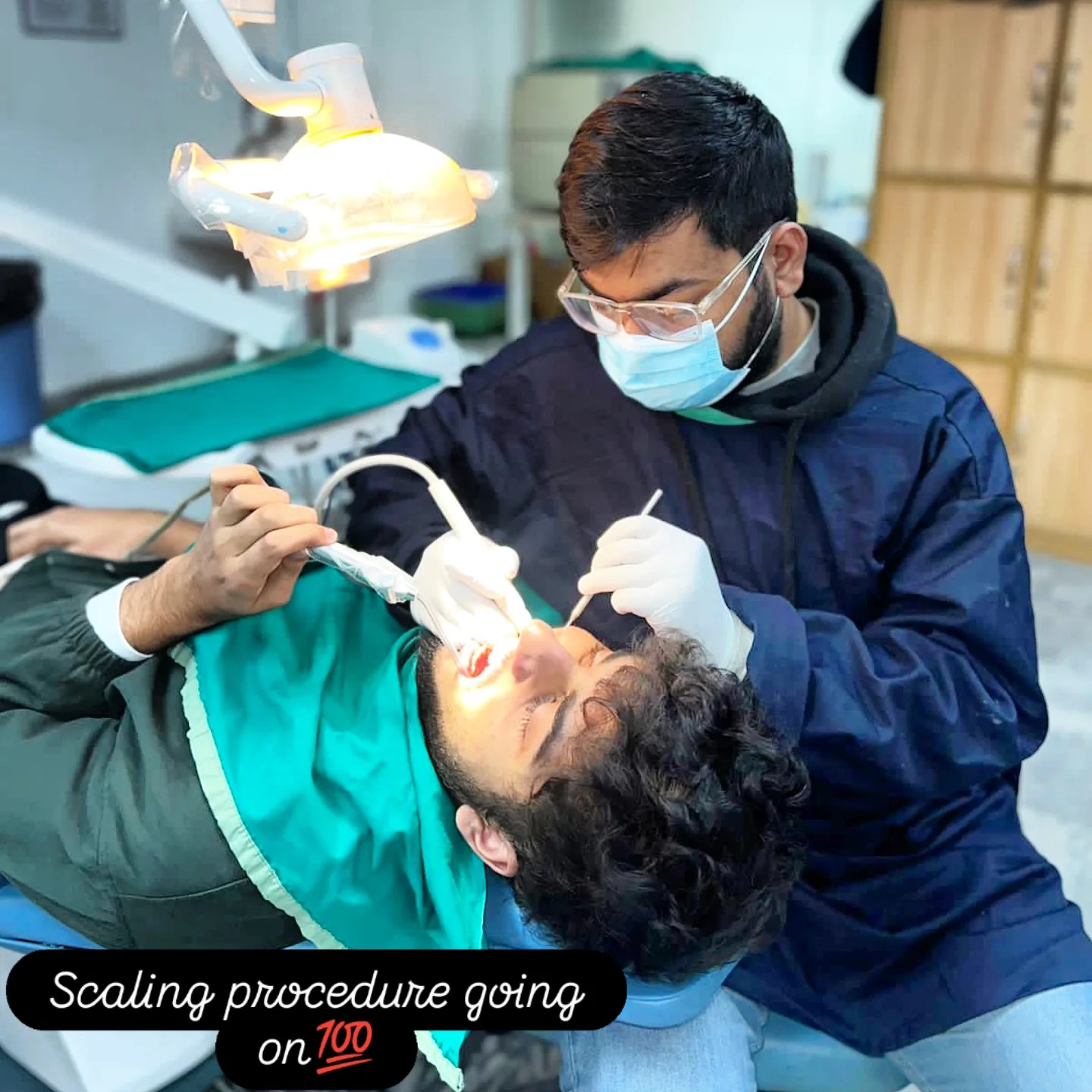
Dr. Mian Momin Ahmad
“Converting a working professional from a removable denture to a fixed bridge is one of the most rewarding cases in general practice. The technical work is routine. The change in the patient's daily life is substantial. Mr. Sajid had been quietly carrying a small daily friction for years, and one well-planned five-week case removed it completely.”
Six habits that protect a fixed bridge for 15 years.
The longevity of a bridge depends almost entirely on what the patient does between visits. These six habits are what we asked Mr. Sajid to commit to.
Floss under each pontic every night
The undersurface of each pontic — the tooth-shaped piece spanning the gap — collects plaque in a way that ordinary brushing cannot reach. Super-floss or a floss-threader, slid under each pontic once a day, takes ten seconds per pontic. This single habit is the most important determinant of bridge longevity.
Use a soft toothbrush at the cervical margin
Hard-bristled brushes accelerate gum recession at the cervical margin of every crown abutment. A soft-bristled brush, used in small circular motions for two minutes morning and night, protects the gum at the most vulnerable site. Oral-B Sensitive or a similar soft head is the right choice.
Avoid biting into hard or very sticky foods on the bridge
A PFM bridge is strong but has an upper limit. Biting directly into apples, hard naan crust, or chicken bones with the bridge units stresses the cement margins in a way the bridge was not designed for. We asked Mr. Sajid to slice food and chew with the back teeth wherever practical.
Don't use abrasive whitening toothpastes
Whitening toothpastes are mildly abrasive and can scratch the surface glaze of a freshly polished PFM crown over time. A regular fluoride toothpaste — Sensodyne Sensitive, Colgate Total — is the right choice. Whitening on the natural teeth in the rest of his mouth is a separate conversation we can have at a future recall.
Come back at six months — every time
Every bridge patient at our clinic comes back at six months for a complimentary marginal check. Twenty minutes per recall. This catches almost every long-term problem at the small-intervention stage.
Tell us about any tenderness or new sensitivity
When a bridge abutment develops a problem, the first sign is almost always a mild tenderness on biting or a new sensitivity to cold. Patients who flag those signs early end up with small interventions; patients who wait end up with bigger ones. We asked him to message on WhatsApp the moment he noticed anything different.
A removable denture is not the end of the conversation. It's often the beginning.
Many patients fitted with a removable denture after a tooth loss assume it is the permanent solution. It rarely is. The denture is a reasonable starting point — it gives the gum time to settle, the patient time to adapt, and the bone time to remodel after the extraction. After a year or two, when both the patient and the tissue have stabilised, the conversation about a longer-term solution can begin.
Mr. Sajid came in at year five. The case was straightforward. Earlier conversion would have been simpler in some ways; later conversion would have been harder. The right time is when the patient is ready.
More on fixed vs removable solutions.
Three more crown and bridge patients.
Tired of a removable denture? Let's look at a fixed option.
The first 15 minutes are free. We will examine the denture, the teeth on either side, and the supporting bone, and put a written plan with both bridge and implant options in your hand. No pressure to commit the same day.