How a Lahore homemaker made tea taste like tea again in one 50-minute visit
Ms. Sameena had stopped enjoying her morning chai because the first sip always made her wince. The yellow stains were the secondary complaint — she had assumed they would have to come and go. The sensitivity, she had assumed at 55 was just her body. It was not. It was the gum line, and a single combined visit — scaling, fluoride varnish and a take-home desensitiser — took her Schiff cold-air sensitivity score from 3 down to 1 across six months. This is the full story.
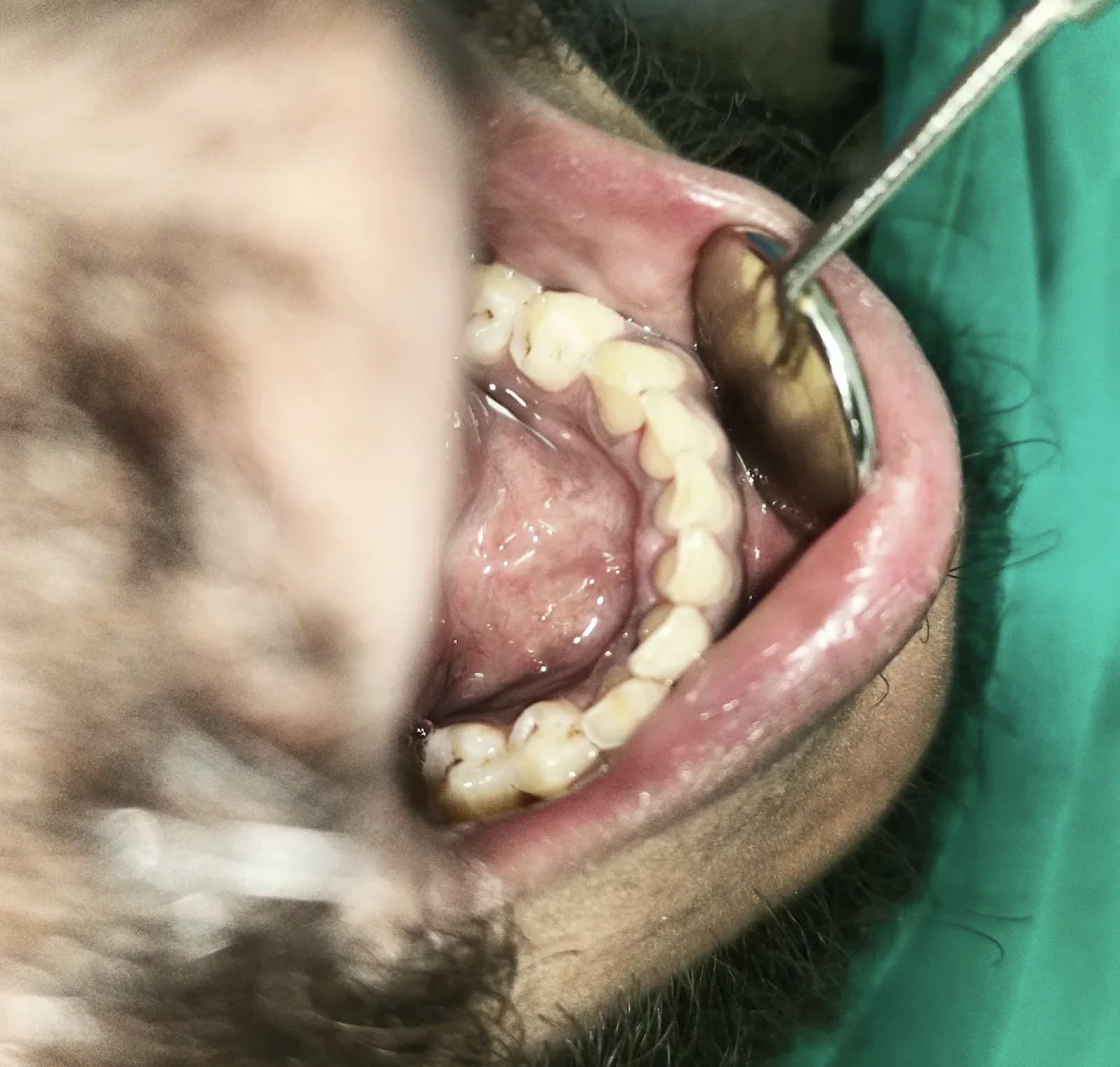
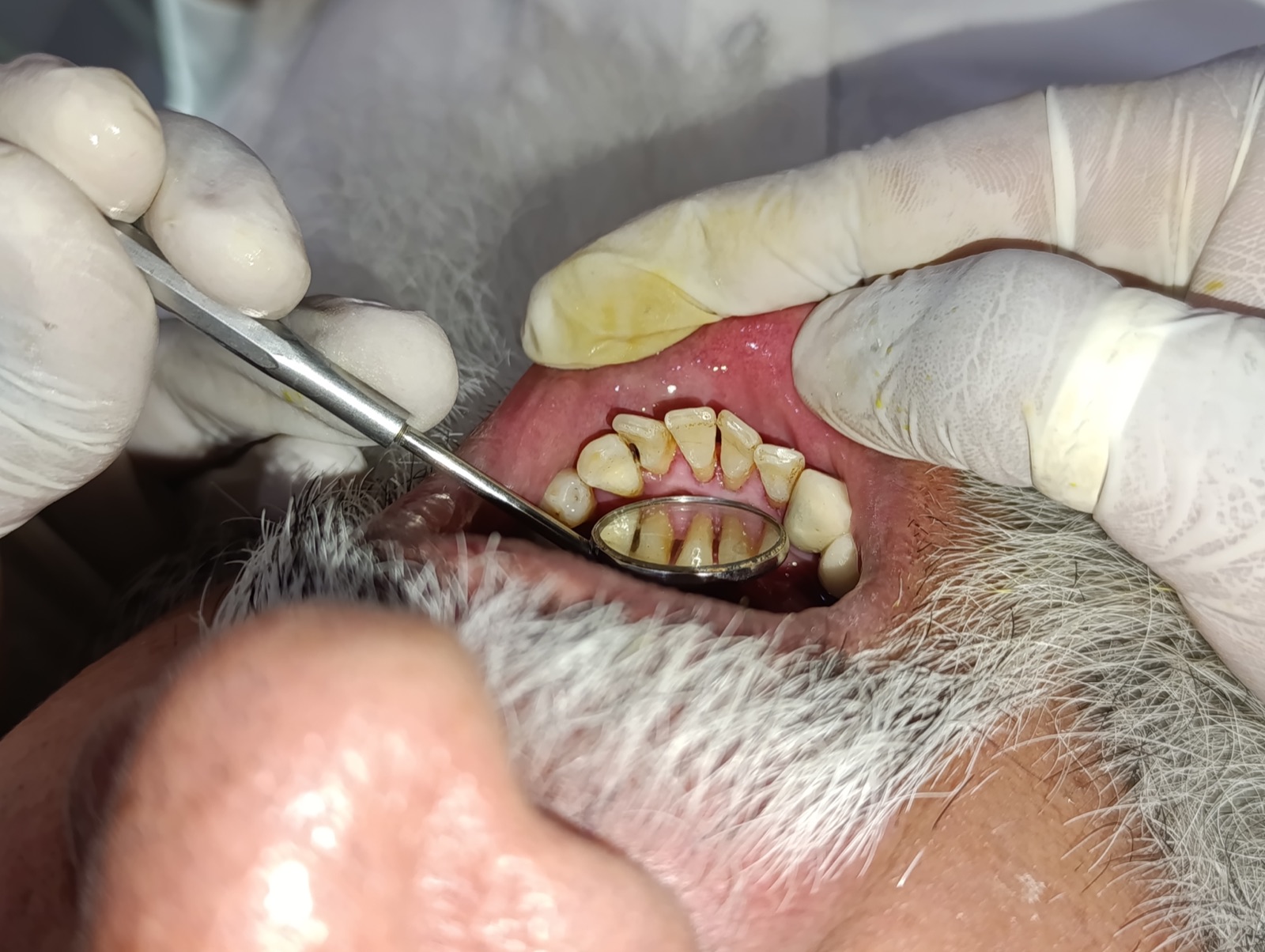
 Before
 After
AfterThe first sip of chai had stopped being the morning's pleasure.
Most patients we see with sensitivity at this stage have lived with it for years, often for a decade or more, on the assumption that it is permanent. Ms. Sameena was one of them. She is the case we keep in mind whenever someone tells us their problem is "just the colour."
Ms. Sameena is 55 years old, a Lahore homemaker, the matriarch of a household of eight. She has three adult children, two daughters-in-law in the home, and a routine that begins at 5:30 every morning with a cup of chai before the rest of the family is awake. That cup of chai is, by her own description, the one moment of the day that belongs entirely to her.
Some time around her late forties, the chai started to hurt. The first sip — the hot one, the one she used to look forward to most — would produce a sharp pulse along her lower-front teeth that took the pleasure out of the next few sips as well. By 53, cold water at the kitchen tap was producing the same pulse. By 55, the air on the way from her bedroom to the kitchen on a December morning was enough.
The yellow discolouration had been visible to her for longer than that, but it was the secondary complaint. What finally brought her to our clinic was not the colour. It was the chai. She had asked her elder daughter what could be done about "teeth that hurt all the time now," her daughter had searched online, found us, and booked the consult on her behalf.
When she arrived for the first appointment, she said something I have heard, in different words, from almost every older patient with sensitivity. She said she had assumed sensitivity at her age was just her body — that this was simply what it felt like to have teeth at 55. She had stopped looking for a fix because she had stopped believing one existed.
We took the standard six photographs. We charted six-point pocket depths around every tooth. We took a panoramic X-ray. And then, importantly, we ran a baseline Schiff cold-air sensitivity test — a brief puff of cool air across each tooth surface, with the patient rating the response on a 0-to-3 scale. Six surfaces returned the maximum 3. We wrote that number down in front of her, because we were going to measure her improvement against it.
The diagnosis was straightforward. Heavy generalised yellow stain — extrinsic, removable. Dentinal hypersensitivity at six cervical sites — caused by gum recession exposing the root surface, driven by years of vigorous horizontal brushing and accelerated by the calculus sitting at the gum line. Bone level on the X-ray, however, was stable. No advanced gum disease. No teeth at risk. What she had was treatable, in a single combined visit, for PKR 6,000 — and it was treatable starting that Tuesday.
We told her this might be the appointment that gave her morning chai back. She was sceptical. She had heard versions of this promise before. We made the appointment for the same Friday.
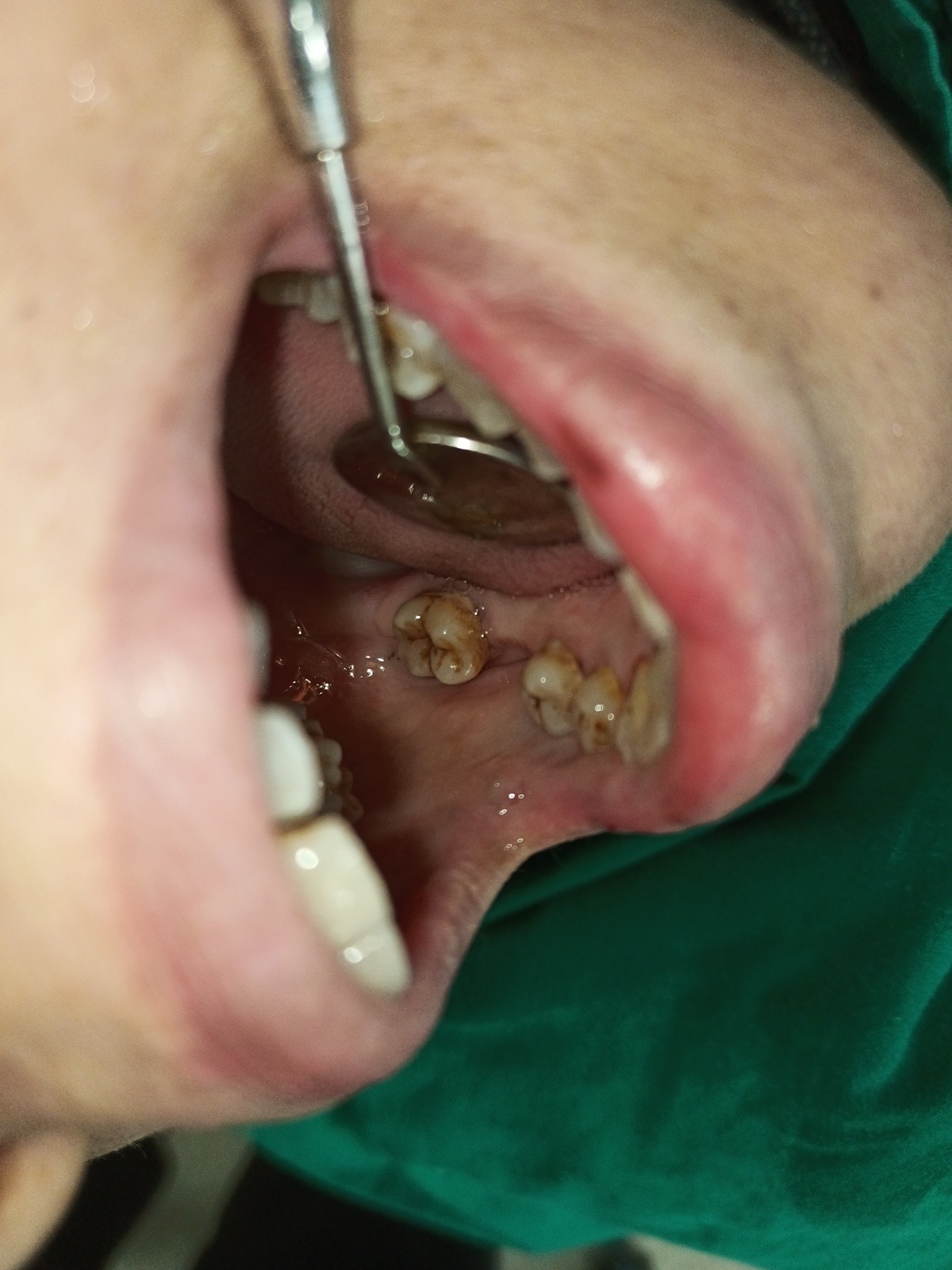
Four findings — the colour was the visible half of a deeper story.
The discolouration was the complaint that brought her in. The sensitivity was the complaint she had accepted. The relationship between the two — and the fact that one visit could resolve both — was the conversation we had to have before any instrument touched the tooth.
Generalised yellow stain — extrinsic and removable
Years of strong chai, family meals heavy in tannins and turmeric, and the daily oxidation that comes from missed pockets at the gum line had laid down a generalised yellow film across all visible surfaces. This is the most common stain pattern we see in older Lahori women — it builds up gradually, and by the time it is noticed, the patient has often concluded it must be permanent. It is not. Tannin stain sits on top of clean enamel. It cannot be brushed off at home, but it can be lifted off entirely with an ultrasonic scaler and a fine prophy paste. The enamel underneath was, in her case, intact.
Dentinal hypersensitivity in 6 sites
When we ran a brief cold-air test along the front and side teeth, six surfaces produced a sharp, pull-away response — the maximum reading on the Schiff sensitivity scale. The cause was not the teeth themselves. It was the gum line, which had migrated apically by one to two millimetres on most teeth from years of vigorous horizontal brushing. That recession had exposed the dentine — the softer, more porous layer underneath the enamel, threaded with microscopic tubules that connect directly to the nerve. Cold air, cold water, cold milk, even just the morning breeze on the way to the kitchen, all triggered the same sharp pulse.
Heavy plaque + calculus — secondary, contributing
A dense band of mineralised tartar sat along the lower-front gum line and behind the upper molars, with softer plaque generalised across most surfaces. This was not the chief complaint, but it was driving the chief complaint. The plaque and calculus were inflaming the gum margins and accelerating the recession that was exposing the dentine in the first place. Treating the sensitivity without first removing the deposits would have been treating the symptom and leaving the cause in place.
Bone level: stable, no advanced gum disease
This was the relief news of the consultation. We took a panoramic X-ray and looked carefully at the bone level around every tooth. The bone was within the normal range for a 55-year-old — no advanced periodontitis, no large defects, no teeth at risk of being lost. What looked dramatic from outside was actually a textbook case of long-standing gingivitis with cervical recession, both of which are treatable with a single combined visit. She did not need surgery, she did not need extractions, she did not need any of the things she had been quietly worrying about for the last five years.
Four steps. All in one sitting.
Every step was explained before it happened. She could see what we were doing in a small mirror at any point. The order matters in this case more than in most — because air-flow at the wrong moment makes sensitivity worse, and we wanted the trajectory to go in only one direction.
Exam + Schiff sensitivity test
We took the standard six photographs and charted the gum at six points around every tooth. Then we ran a baseline Schiff cold-air sensitivity test — a brief, gentle puff of cool air across each tooth surface, with the patient rating the response on a 0-to-3 scale where 3 is "I have to pull away" and 0 is "I felt nothing." Six surfaces returned a 3. We wrote that number down so we could measure improvement against it at every follow-up.
~ 10 minTopical numbing at the dense cervical band
For the band of dense calculus along the lower-front gum line — the same region that was scoring 3 on the Schiff test — we applied a topical anaesthetic gel with a cotton bud. No injection. The gel takes about three minutes to work and dulls the area completely without numbing the lip or the tongue. She remained fully aware and could speak normally throughout.
~ 5 minUltrasonic scaling — air-flow avoided at sensitive sites
A small ultrasonic tip with continuous water cooling lifts mineralised deposits off in tiny layers. Order: upper right, upper left, lower left, lower right. The yellow-brown deposits shed in sheets from the upper posterior teeth within the first few minutes; the lower anteriors needed slower passes around the cervical band. Air-flow polishing — which is excellent for stain on healthy enamel — was deliberately avoided at the exposed-dentine sites, because air-flow on exposed dentine increases sensitivity in the short term.
~ 25 minFluoride varnish + take-home desensitiser
A 5% sodium-fluoride varnish was painted across the cervical thirds and exposed dentine and left to set for sixty seconds before she sat up. Fluoride varnish blocks the microscopic tubules in the dentine for about three months — long enough for her gum margins to calm down and for a daily desensitising toothpaste to take over the long-term work. We sent her home with a tube of potassium-nitrate paste (Sensodyne or equivalent) and a written usage card. Her next Schiff re-test was scheduled for one week.
~ 10 min During — ultrasonic
 After — final polish
Same patient. Same chair. Same Friday.
Drag the divider across the photo to compare. Both photos were taken with the same camera and lighting inside our Lahore clinic — "before" right as she sat down, "after" before she stood up. The colour change is dramatic. The sensitivity change, the part you cannot see, is the part she came in for.
BeforeAfterWhy cold chai should not hurt at 55.
Patients often ask, reasonably, why the morning chai started hurting in the first place — and whether the hurt has to be permanent. The honest answer has three parts. None of them are about your age.
Dentine has microscopic tubules that lead to the nerve
Underneath the enamel — the hard, white outer layer of the tooth — sits dentine. Dentine is softer and more porous, threaded with thousands of microscopic tubules that connect, eventually, to the nerve at the centre of the tooth. As long as the dentine is covered by enamel above the gum line and by cementum below it, the tubules are sealed off and the nerve never feels anything from outside. Cold and hot stimuli stay where they belong — outside the tooth.
Recession exposes the dentine — and opens the tubules
When the gum migrates apically — even by one or two millimetres, which is exactly what years of vigorous horizontal brushing produced in Ms. Sameena — the cementum on the root surface is exposed and quickly worn through. The tubules are now open to the outside. Cold air, cold water, cold milk all produce a tiny fluid shift inside the tubules, which the nerve registers as a sharp pulse. That pulse is what she was feeling on the first sip of chai every morning.
Fluoride varnish blocks the tubules. Potassium nitrate calms the nerve.
Modern sensitivity treatment works on both ends of the tubule. A 5% sodium-fluoride varnish, painted in clinic, deposits a thin protective layer that physically blocks the open tubules for about three months. A daily potassium-nitrate toothpaste, used at home, gradually depolarises the nerve endings inside the tubules — calming the response itself. The two together are why her Schiff score moved from 3 to 1 in six months. Neither alone would have produced the same result.
Five questions our older patients always ask.
These are the worries we hear most often from patients in their fifties and sixties with sensitivity, in the words they actually use. Tap any one to read the long answer.
My teeth are already sensitive — will scaling make it worse?+
This is the worry that kept Ms. Sameena out of the dental chair for almost five years, and it is the single most common worry we hear from older patients with sensitivity. The honest answer is: in the short term, sometimes briefly — yes. In the medium and long term, no, and the alternative of not cleaning is much worse.
Here is why. The tartar sitting on the exposed root surface acts as an unintentional insulator. When we remove it, the dentine underneath is briefly exposed to cold air and water, and sensitivity can spike for one to three days. We anticipate this. That is why every sensitivity case at our clinic gets a fluoride varnish at the end of the same visit and a take-home potassium-nitrate paste from day one. The varnish blocks the tubules immediately. The paste takes over from there.
Within seven days, almost every patient on this protocol reports the sensitivity is lower than it was before the cleaning. By one month it is significantly lower. Ms. Sameena's Schiff score went from 3 to 2 in seven days, and from 2 to 1 by six months. The cleaning did not make her sensitivity worse — it made it the lowest it had been in years.
Why is sensitivity treatment an extra charge? What does it actually involve?+
The standard scaling and polishing is PKR 4,500. The sensitivity treatment is an additional PKR 1,500, and it is a genuinely separate service — not a hidden upsell.
It involves three things. First, a baseline Schiff cold-air test, which adds about ten minutes to the exam and is the metric we measure improvement against. Second, in-clinic application of 5% sodium-fluoride varnish to the exposed dentine — this requires the right product, takes about ten minutes including drying time, and provides three months of tubule blockage on its own. Third, a written take-home regimen including the right toothpaste, the right brushing technique, and the timing of food and drink around brushing.
Patients who have only stain — no sensitivity — do not need this and we do not charge them for it. Patients like Ms. Sameena, who have sensitivity, need it and we charge for it. The total of PKR 6,000 includes everything.
I am 55 — is sensitivity at my age just a permanent part of getting older?+
No. This is the assumption that makes dentinal hypersensitivity one of the most under-treated complaints in older patients, and it is wrong almost every time.
Sensitivity at 55 is almost never a function of the age itself. It is a function of two things: gum recession that has exposed the root surface, and a daily routine that keeps the tubules in that exposed surface open. Both of those are addressable. The recession can be stabilised by changing brushing technique. The tubules can be blocked by fluoride varnish in clinic and potassium-nitrate paste at home. Within four to six weeks of starting both, the sensitivity drops dramatically in almost every patient.
Ms. Sameena had been quietly assuming for years that her morning chai had to hurt because she was getting older. The first sip of chai on the morning after her appointment did not hurt. The cause was the gum line, not the body.
How long will the result last? Will the stains and sensitivity come back?+
The stain answer is the easy one: yes, slowly, if you do nothing. No, for years, if you change one or two small habits. The single most useful habit is a five-second water rinse after every chai. Patients who do this consistently come back to the same chair every six months for a routine 30-minute clean. Patients who don't, come back every three months for a heavier one.
The sensitivity answer is more interesting. The fluoride varnish gives three months of direct tubule blockage. The potassium-nitrate paste, used twice daily, takes over from there and keeps the sensitivity suppressed indefinitely. Stop using the paste for two weeks and the sensitivity quietly creeps back. Use it as your regular toothpaste — which is what we ask Ms. Sameena to do — and the sensitivity stays at 1 of 3 or lower for years.
We re-test every patient at the six-month recall, every twelve months thereafter, and the Schiff number goes into her record. You can see your own trend on a printed sheet, and we adjust the protocol if anything starts moving in the wrong direction.
How much does this cost? Are there hidden charges?+
Ms. Sameena's total was PKR 6,000 — PKR 4,500 for the deep scaling and polish, PKR 1,500 for the sensitivity treatment (the Schiff test, the fluoride varnish, the take-home regimen). That fee is all-inclusive — it covers the full chart, the X-rays, the topical numbing gel, the ultrasonic scaling, the rubber-cup polish, the varnish application, and the printed aftercare sheet she took home.
There is no extra charge for the consultation — the first 15 minutes are free for every patient. There is no charge for the photographs. If we discover during the exam that you actually need deeper work — root planing per quadrant, for example — we will stop, show you the X-ray, explain why, and write a separate quote before we proceed. Nothing happens without your sign-off.
Her six-month recall — routine maintenance scaling, with another Schiff test — was PKR 4,500. Future six-monthly visits will be the same fee unless something on the chart changes.
The follow-up visits.
One scaling is not the end of a sensitivity case — it is the beginning of a measured trajectory. Every sensitivity patient at our clinic gets four scheduled touchpoints with a Schiff re-test at each one, so we can prove the protocol is working with numbers and not just feelings. Here is how Ms. Sameena's went.
She came in for a fifteen-minute review at one week. Schiff cold-air sensitivity reduced from 3 to 2 across the lower anteriors. Cold water at the tap was "noticeable but not painful." The morning chai was being drunk without flinching for the first time in years. Modified Bass technique was already in daily use. Gingival margins visibly calmer. Photographs retaken so we had a clean baseline going forward.
Ms. Sameena messaged on WhatsApp at the four-week mark. The desensitising toothpaste was being used twice a day every day. Tea had returned to baseline pleasure. The interdental brush was being used nightly. The hard horizontal scrubbing had been replaced — by her own report — with the small, angled, gentle technique we demonstrated. Schiff stable at 2. No further intervention required.
At the three-month review, the Schiff cold-air score dropped to 1. Mild stain re-accumulation visible on the upper buccal surfaces — within expected range for a chai drinker. Brief touch-up scaling performed in the same chair, no fluoride varnish needed yet. Recall extended to six months.
She returned in July for the six-month recall. Schiff stable at 1. Routine maintenance scaling performed in 30 minutes. Gum recession unchanged — no new exposure. Recall extended to a six-monthly cadence going forward, photographs filed against the January baseline. She paid PKR 4,500 for the routine clean. Her next visit is on the calendar for January 2026.
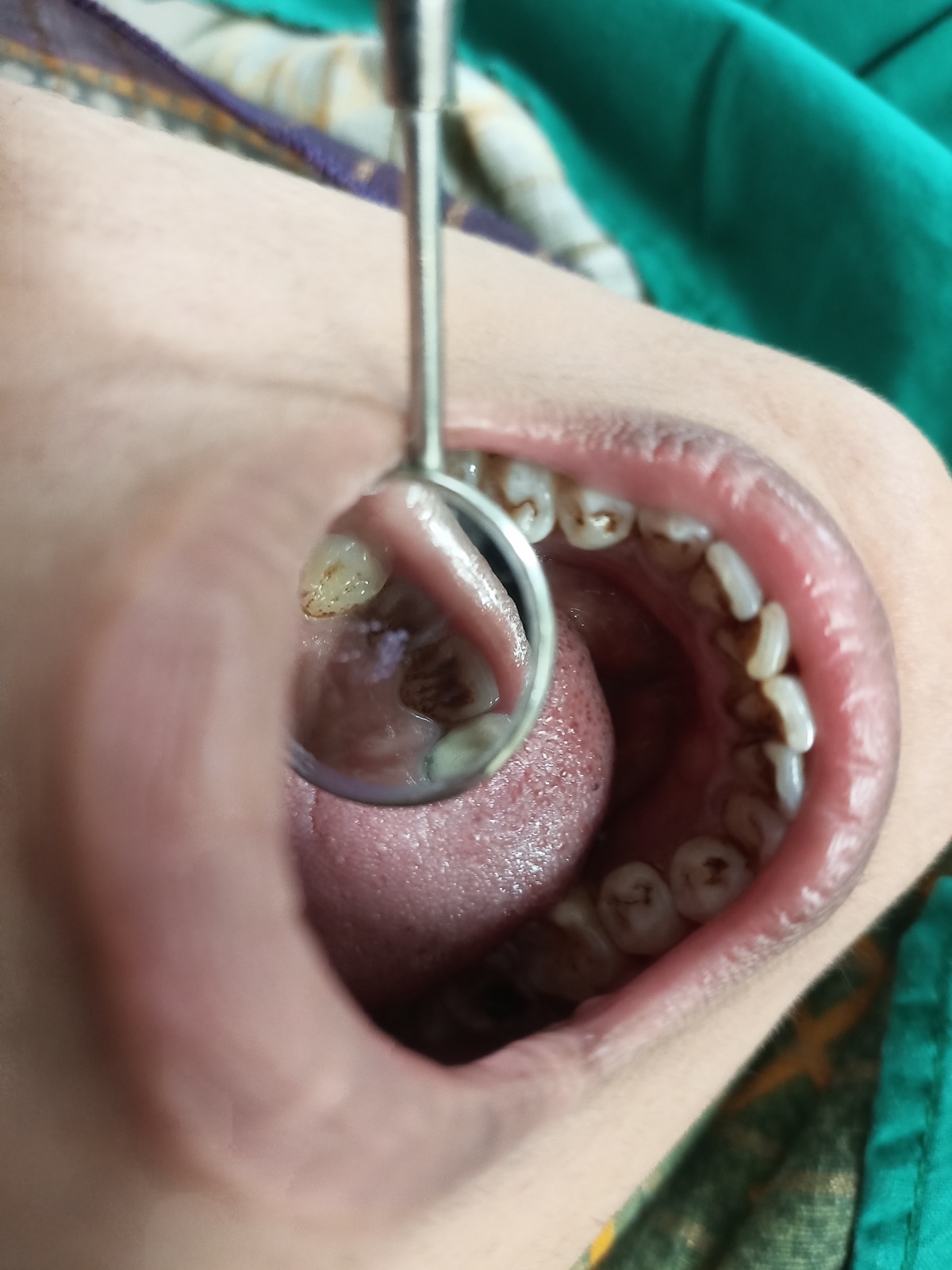
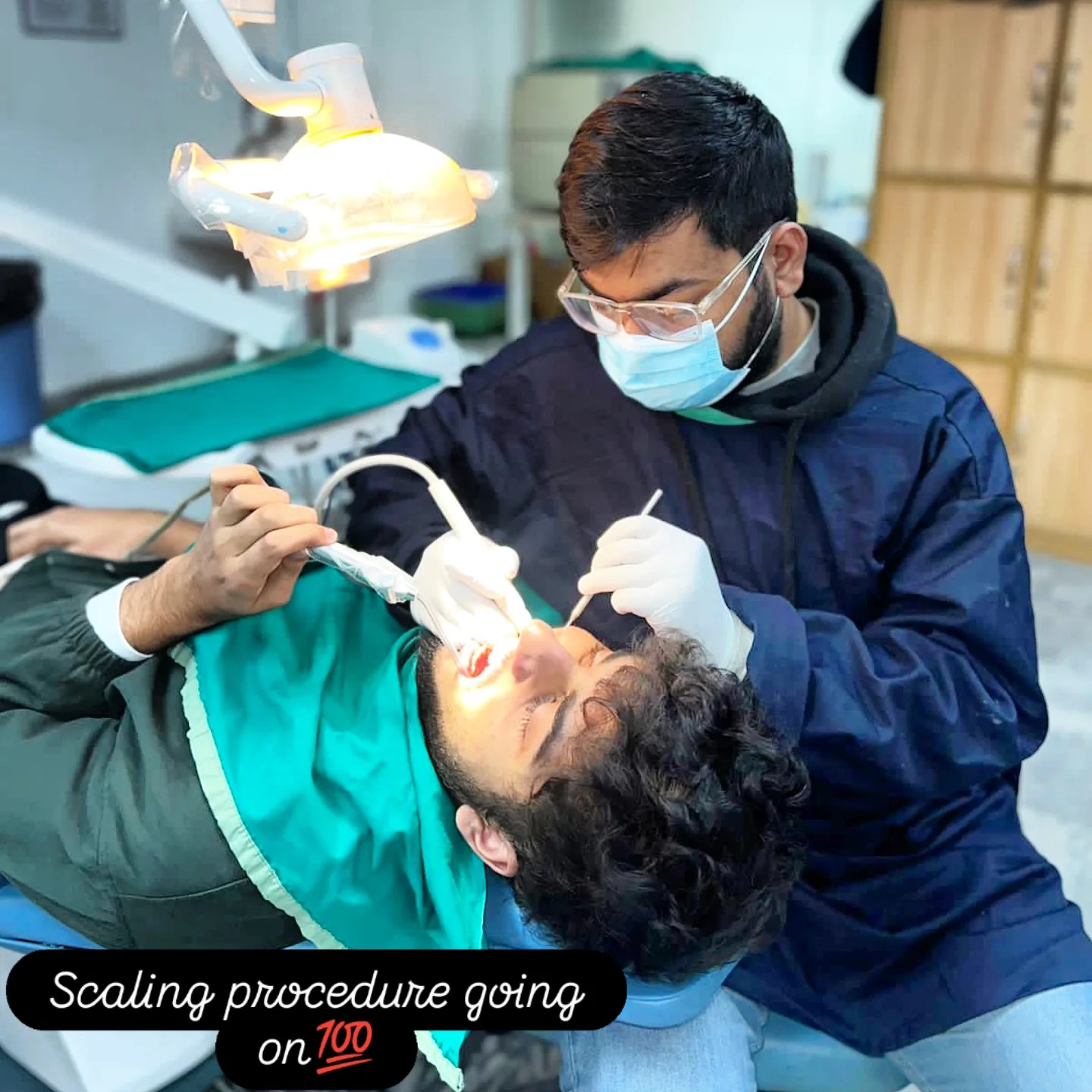
Dr. Mian Momin Ahmad
“Dentinal hypersensitivity in older patients is one of the most under-treated complaints in dentistry. Patients assume it is age, and stop looking for a fix. It is almost never age. The fix is usually the same protocol — clean the gum line, apply fluoride varnish in clinic, switch to a potassium-nitrate paste at home, change the brushing technique. Within four to six weeks, in almost every patient, the sensitivity drops dramatically. The reason I track the Schiff score on every sensitivity case is so the patient can see, in numbers, that the fix is working — and so we can both be honest at six months about whether the protocol needs adjusting. Ms. Sameena went from 3 to 1 across six months. Her morning chai is hers again.”
Six small habits that hold the result.
A clean is not the end of the story for a sensitivity case. The teeth stay this way — and the sensitivity stays at 1 of 3 — only if a few small things are done at home. These six are the only ones we asked Ms. Sameena to commit to.
Switch to a soft brush + correct technique
The cervical recession we found was driven, primarily, by years of vigorous horizontal scrubbing with a medium-bristled brush. That technique slowly wears the gum away and exposes the root surface — exactly the dentine that was producing her sensitivity. We sized her for an Oral-B sensitive brush and demonstrated the modified Bass technique chair-side: small, gentle, angled circles at the gum line, not horizontal scrubbing. Ten years of doing it the wrong way is what brought her in. Ten years of doing it the right way is what keeps her here.
Sensodyne Pronamel or similar potassium-nitrate paste
Twice a day, for at least four weeks, then continued long-term as her regular toothpaste. Potassium nitrate (KNO₃) works by gradually depolarising the nerve endings inside the dentinal tubules — it does not block them, it calms them. The effect builds over two to three weeks of consistent use and is lost within a week if she stops. We told her to think of it not as a temporary medicine but as the toothpaste she now uses indefinitely. The fluoride varnish handles the first three months while the KNO₃ paste catches up.
Wait 30 minutes after acidic foods before brushing
Lemon, pickle, vinegar, even tea immediately after a meal — all temporarily soften the enamel surface for about half an hour. Brushing during that window scrubs softened enamel away and accelerates the very wear we are trying to stop. We asked her to wait at least 30 minutes after acidic foods before brushing. A glass of plain water in between is fine. The chai in the morning is fine. The brushing is what waits.
Five-second water rinse after every chai
She drinks chai three to four times a day with the family. That is three or four pigment exposures, every day, every year. A five-second rinse with plain water immediately after the cup is finished removes most of the tannin film that would otherwise sit on the teeth and re-build the stain. This is not optional advice — it is the difference between coming back at six months for a routine clean and coming back at three months for a heavier one. No equipment, no cost.
Floss + a TePe size 2 interdental brush
Some of her embrasures — the small triangular spaces between teeth where the gum has receded slightly — are too wide for floss alone to clean effectively. A TePe size 2 interdental brush slides through those spaces, lifts more debris, and is gentler on the gum than aggressive floss snapping. Once a day, last thing at night, after the second brushing. She left the clinic with a four-pack so she would not run out before the first follow-up.
Six-month recall + Schiff re-test on every visit
Tartar reforms. Dentinal sensitivity is a chronic condition that needs measurement, not just memory. At every recall — six months from the day, again at twelve, and forever after — we will run the same Schiff cold-air test on the same six surfaces and compare the score against the baseline. Her trajectory is already clear: 3 at the first visit, 2 at one week, 1 at six months. That is the metric we are watching, and it is more important than the photographs.
Many older patients live with daily sensitivity assuming it is age. It almost never is.
We do not lecture about postponement. The reasons we hear from older patients are real — a household to run, an assumption that nothing can be done, a fear that the dental visit will somehow make the sensitivity worse, a generation that grew up before fluoride varnish and potassium-nitrate paste were routine. None of those are stupid. They are why so many sensitivity cases sit untreated for a decade or more.
What waiting another year or two actually does, in plain terms:
None of that is a scare tactic. It is the timeline we see, in our chair, in this clinic, every week. The fix at this stage is still a single 50-minute combined visit. The fix in five years is rarely as simple.
More on scaling, sensitivity and the conditions behind them.
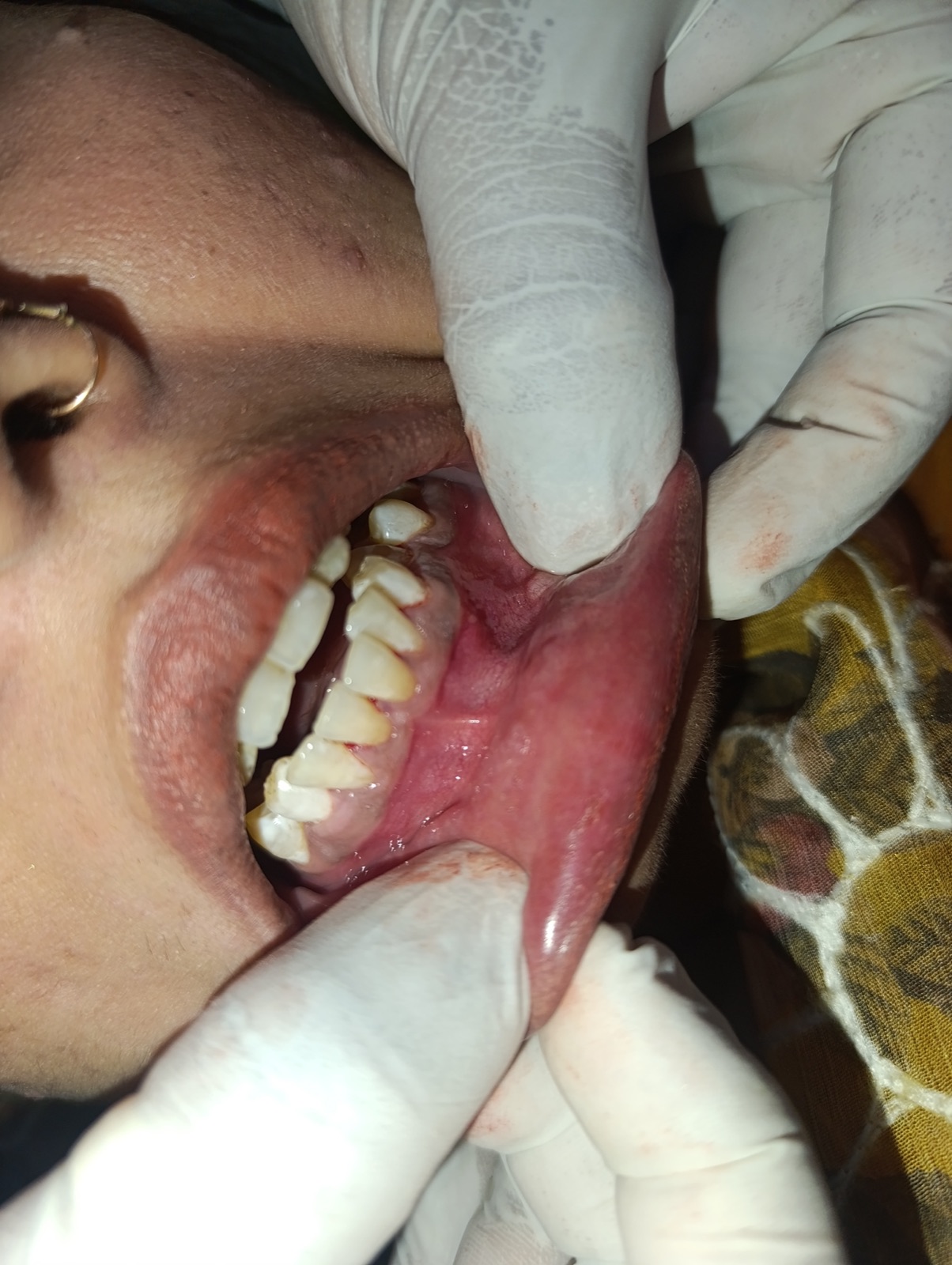
Three more patients like Ms. Sameena.
Every case in this archive is a real Odonto patient with their consent. Names are accurate where the patient was happy to share them, age ranges are real, and every photograph was taken in our Engineers Town clinic.
Want a result like Ms. Sameena's?
The first 15 minutes are free. We will examine your teeth, run a Schiff cold-air sensitivity test, take any photos needed, and put a written quote in your hand. There is no pressure to book the cleaning the same day, and there are no hidden charges if you do.