How a 25-year-old Lahore field engineer stopped early gum disease before it became permanent
Mr. Subhan came in for sensitivity to hot and cold water. We found something more — early gum disease, with the first signs of bone loss. He was twenty-five, which is unusual, and the diagnosis caught him off guard. The honest news was that catching it at this stage means non-surgical treatment can stop the disease in its tracks. The honest work was two visits of deep scaling, and a real change in how he cleans his teeth at home. This is the full story of how that played out.
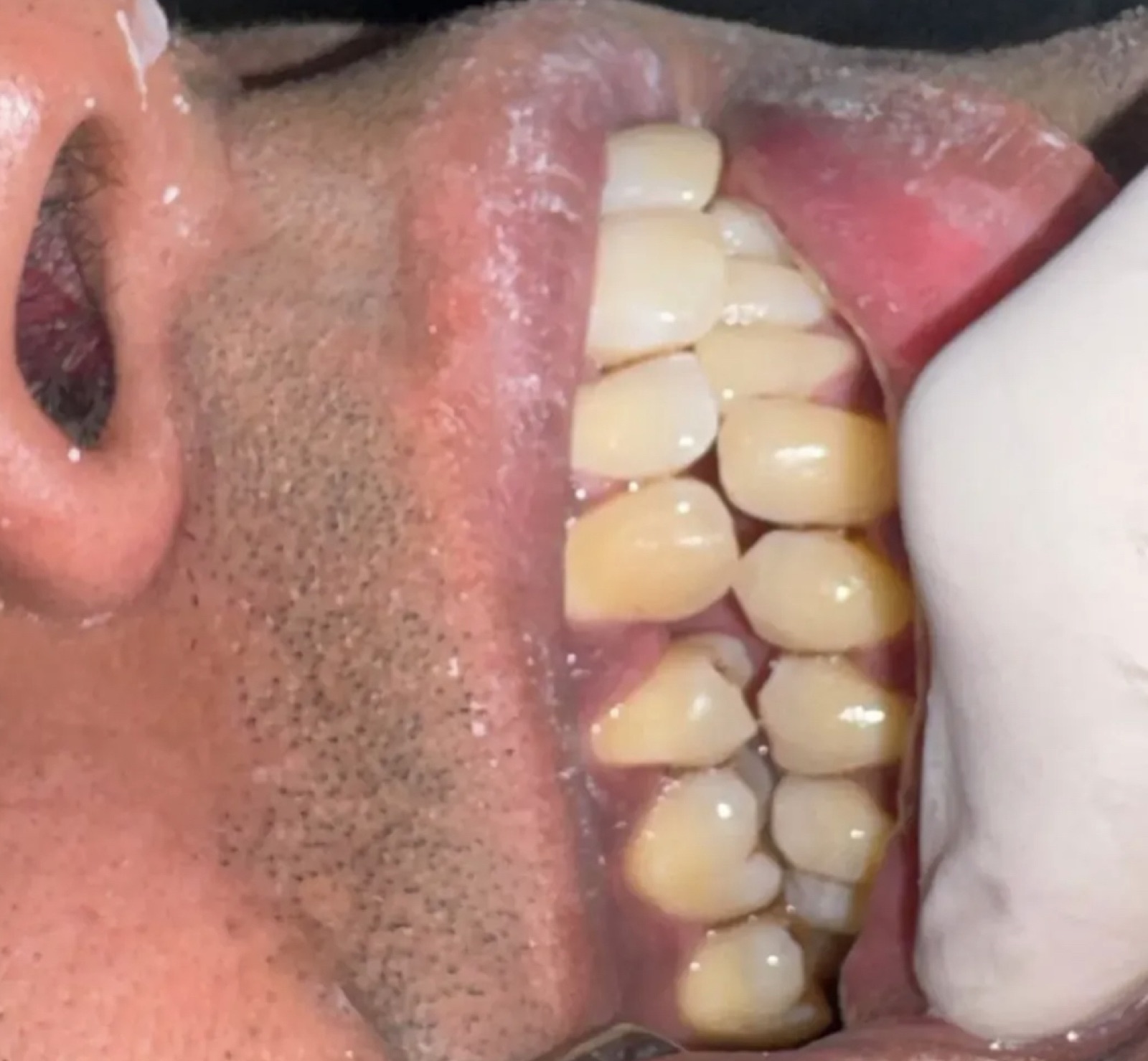
 Before
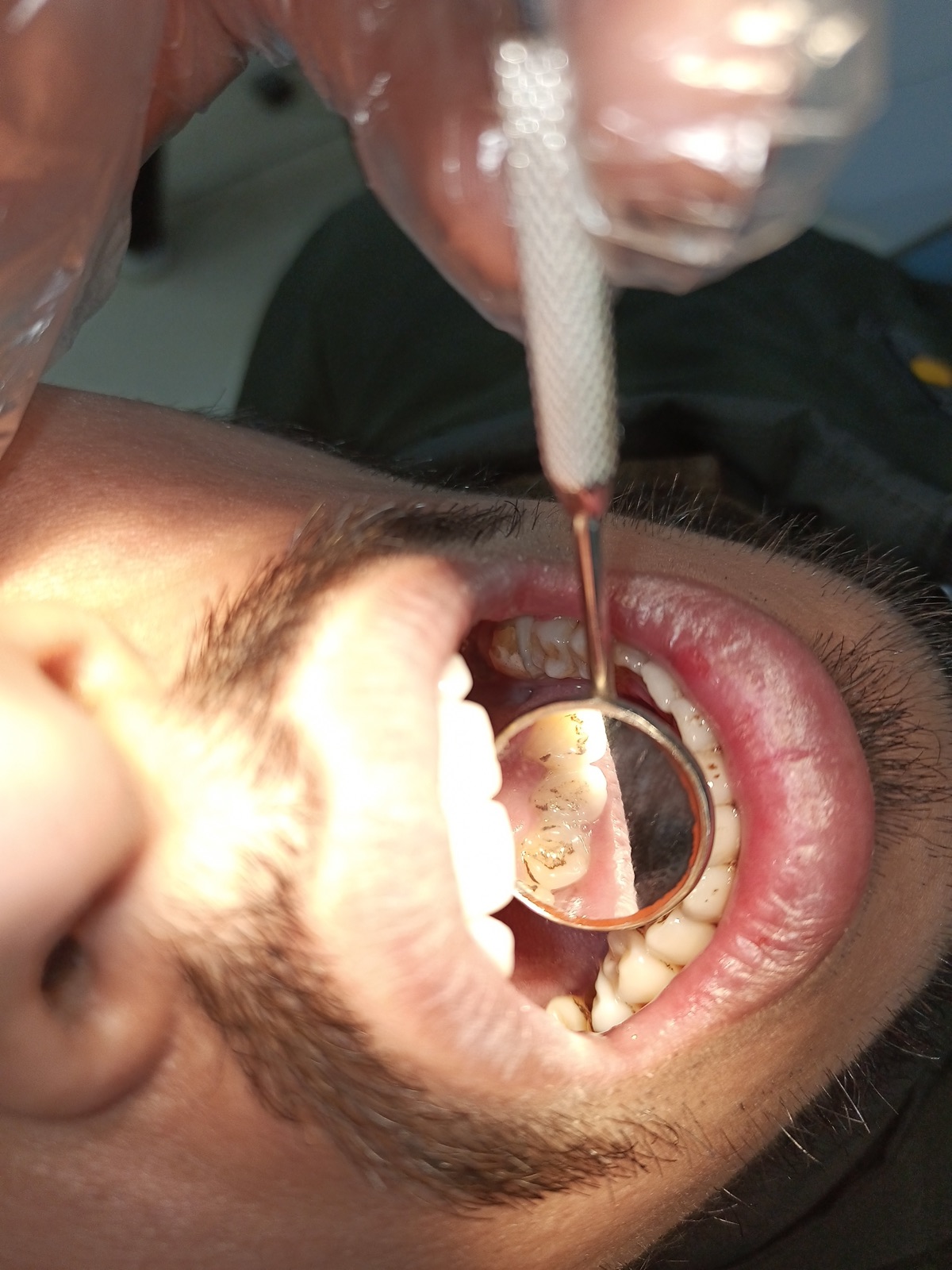 After
AfterHe came in for sensitivity. He left with a real diagnosis.
Periodontitis at twenty-five is uncommon, and worth catching. Most of the patients we see with this pattern of disease are in their forties or fifties, and by then more of the bone has already gone. Mr. Subhan had a chance many of them did not.
Mr. Subhan is twenty-five. He works as a field engineer on industrial sites around Lahore — long shifts outdoors, dust, sun, irregular meal times, and a steady stream of strong chai through the day to keep the energy up. The last time he had seen a dentist before walking into our clinic was four years ago. He brushes twice a day, with toothpaste, like most people his age.
What brought him in was a sensitivity that had been getting worse for a few months. Anything cold — water, kulfi, even the breeze on a winter morning — was making him brace. He had assumed it was a brushing-too-hard problem and had switched to a more expensive toothpaste. The toothpaste had not helped. He came in expecting to be told he needed a stronger desensitiser.
The first appointment ran an hour. We took six standardised photographs from the same angles we use for every patient. We measured his gum at six points around every tooth — a process called charting. We took bitewing X-rays and looked at the bone level around each molar carefully. Then we sat back and delivered the news in plain language, in the order of magnitude in which it mattered.
The good news: no cavities, no abscesses, no root canal work needed, the tooth structure is fine. The harder news: this was not a sensitivity case. The pockets in his back teeth measured four to six millimetres deep. The bitewings showed early bone loss in the molar region — about twenty to thirty percent. The diagnosis is Stage II generalised periodontitis, Grade B.
We did not soften it and we did not dramatise it. Periodontitis at twenty-five is uncommon. It is also, at this stage, firmly treatable without surgery — which is the part that mattered to him most. The work ahead would be two visits of deep scaling under local anaesthesia, a three-month review, and a real change in how he cleans his teeth at home for the rest of his life. We told him on day one: the fix at twenty-five is multi-quadrant scaling. The fix at thirty-five would be surgery. The reason this case is worth taking seriously is precisely because it is still in the first column.
He took it well. He asked the right questions. He booked the first visit for the following Saturday.
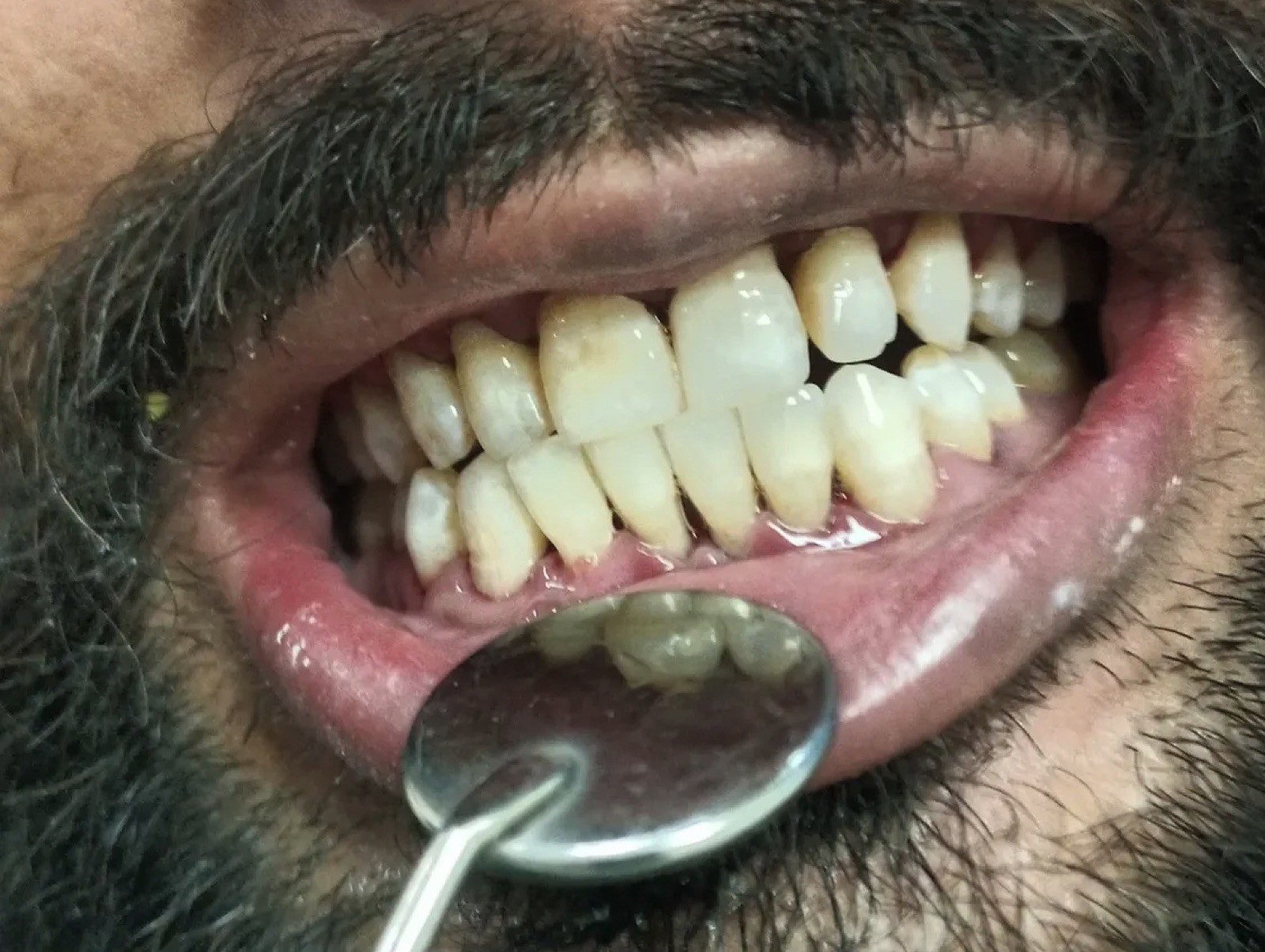
Four findings — explained honestly.
Three of the four findings below are real warnings. We do not minimise them. We also do not catastrophise them — at this stage, every one of them has a clear, non-surgical answer.
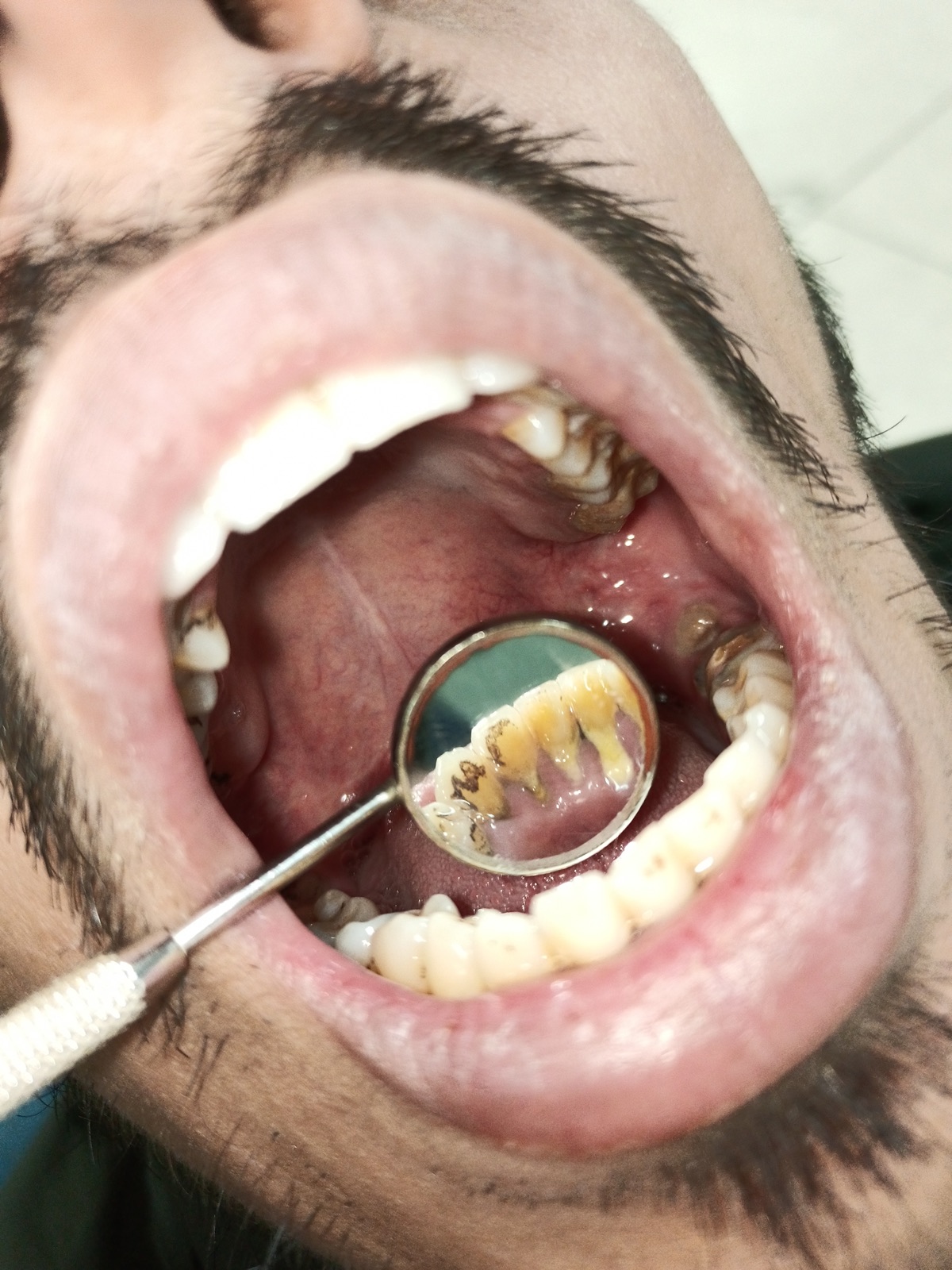
Heavy calculus throughout
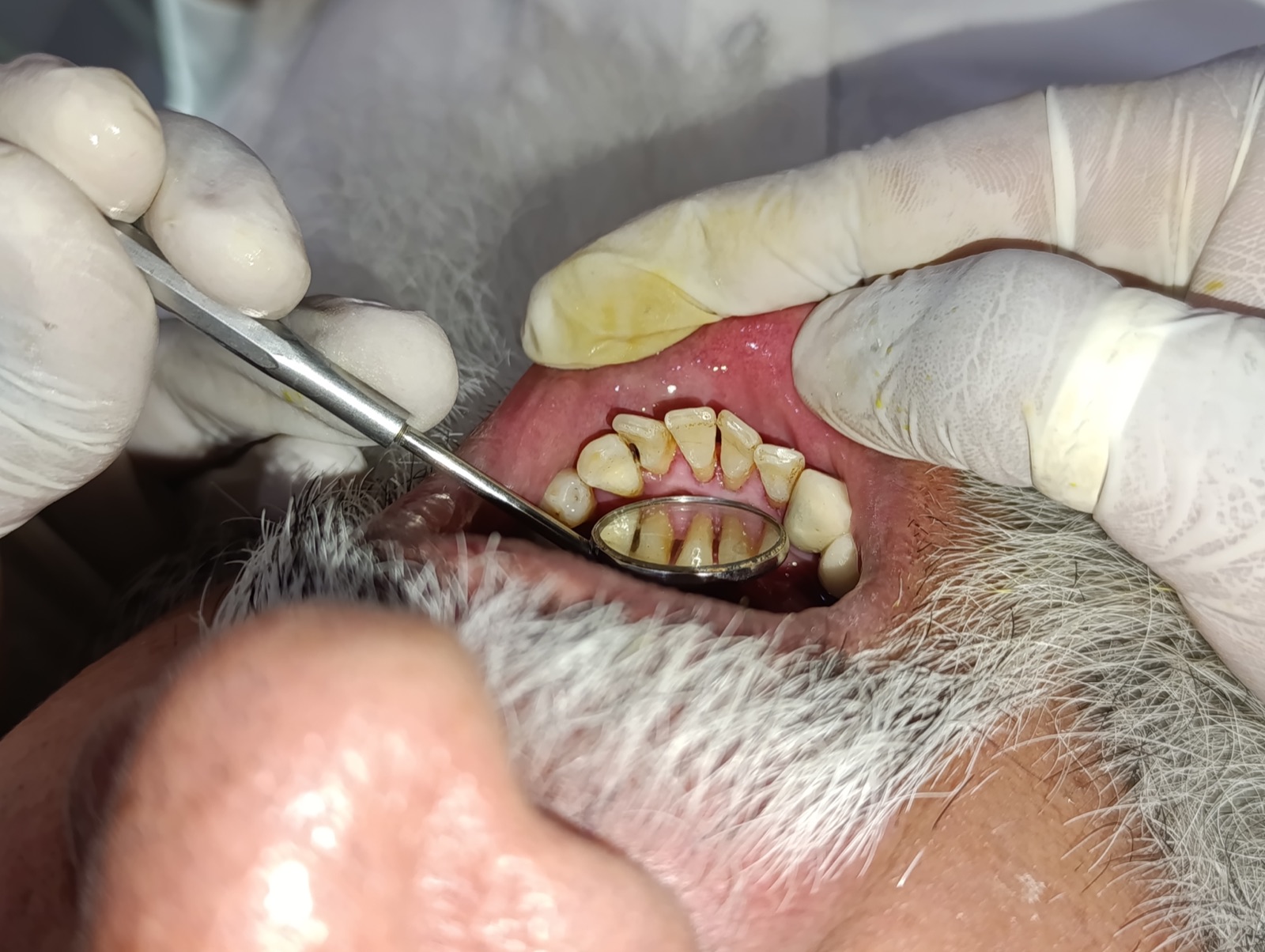
Calculus is hardened plaque. Once it forms, no toothbrush in the world can remove it. Mr. Subhan had a thick, shelved layer of it sitting around the necks of nearly every tooth — supragingivally where we could see it, and subgingivally where we could only feel it on the probe. Years of long shifts on industrial sites, frequent chai for energy, and a four-year gap since his last cleaning had let it build steadily. The bacteria that live in calculus do not just sit there politely — they irritate the gum, deepen the pocket, and quietly invite the next stage of the disease.
Gum pockets at 4–6 mm in the back teeth
A healthy gum hugs the tooth tightly — like a turtleneck. We measure how snugly it hugs at six points around every tooth, with a fine ruler. Anything one to three millimetres deep is normal. Mr. Subhan was reading four to six millimetres in his molars. In plain terms: the gum is no longer hugging those teeth tightly, and a small space has opened up where bacteria can hide from his toothbrush. The four-millimetre sites are still very treatable. The six-millimetre sites are the ones we will be watching closely at the three-month review.
Early bone loss on X-ray — 20 to 30% in the molars
This is the finding that named the diagnosis. The bone that holds your teeth in place is supposed to sit right at the neck of every tooth. On Mr. Subhan's bitewings, the bone at the back molars had quietly stepped down by twenty to thirty percent. Honest framing: this is real, it is the reason we cannot treat his case as a single-visit cleaning, and it is also exactly why catching it now matters. Bone that has receded does not grow back on its own — but at this stage we can stop the receding. That is the whole point of the next two visits.
No cavities — this is gum disease, not decay
This was the part of the consultation that mattered to him most. Every chewing surface was checked carefully. Every tooth was X-rayed for hidden decay. There were none. No fillings, no root canals, no crowns needed. The disease here is purely periodontal — the gum and bone, not the tooth itself. The tooth structure is fine. That changes the conversation completely: the work to do is at the gum line, not inside the tooth. We told him this on day one, in those exact words.
Four steps. Across two visits.
This is not a single-visit case. We split the work across two appointments, one week apart, with proper local anaesthesia each time. Every step was explained before it happened, and he could see the work in a small mirror at any point.
Examination, charting + the honest conversation
Six standardised photographs. Six-point pocket chart around every tooth, recorded onto a paper grid. Bitewing X-rays for the molars, periapical X-rays for any spot that looked questionable. Then we sat with him for nearly twenty minutes and walked through what we were seeing, on the screen, tooth by tooth. The diagnosis — Stage II generalised periodontitis — was delivered without softening it and without dramatising it.
~ 25 minVisit 1 · proper local anaesthesia for the upper quadrants
Pockets at four to six millimetres do not respond comfortably to topical numbing alone. We used proper local anaesthesia — a small lignocaine injection per quadrant, not just gel — so that the deep work could be done without him bracing in the chair. Buccal and palatal sites both. Two minutes to take, ten minutes to take effect.
~ 5 minVisit 1 · deep scaling + Gracey hand work · upper arch
Ultrasonic scaler first, with a continuous water spray, to lift the bulk supragingival calculus and clear the field. Then site-specific Gracey curettes for the true subgingival debridement — these are fine hand instruments shaped for specific tooth surfaces. Tactile end-point: a glass-smooth root surface verified with a fine explorer. This is the work that the three-month review will actually grade.
~ 50 minVisit 2 · one week later · lower arch + review pathway
A week later he came back for the lower quadrants. Same protocol, same care, same anaesthesia. At the end of the second visit we booked his three-month re-charting appointment before he left the chair, sized him up for an interdental brush, gave him a chlorhexidine rinse to use for fourteen days, and made the contingency plan explicit: if the three-month chart shows residual deep pockets, we have a frank surgical-referral conversation then.
~ 50 min Visit 1 · UR + UL
 Visit 2 · LR + LL
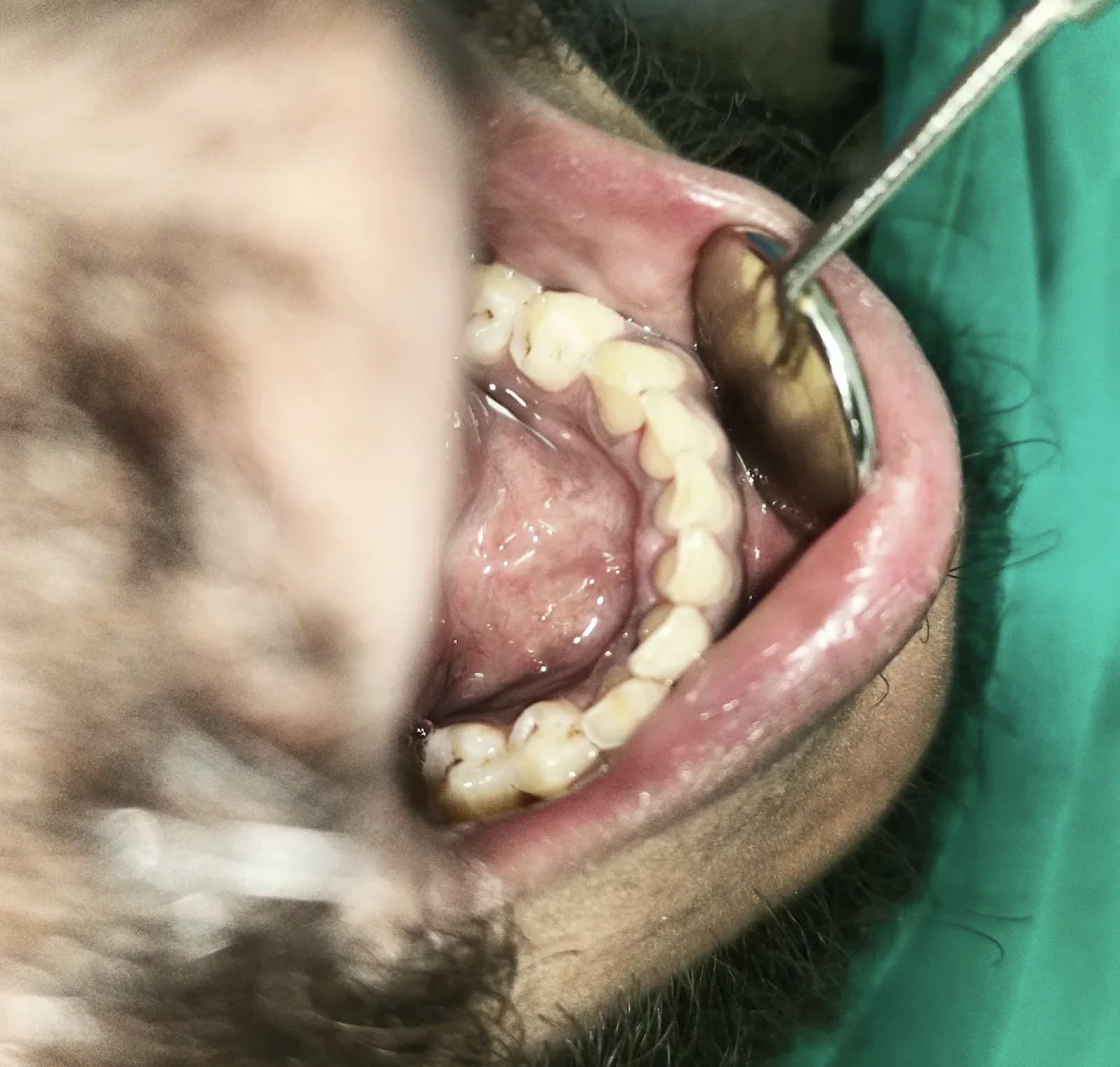
Same patient. Two visits, one week apart.
Drag the divider across the photo to compare. The "before" was taken at the start of visit one; the "after" was taken at the end of visit two, with the same camera and the same lighting at our Lahore clinic.
BeforeAfterWhy this is a different cleaning from the routine one.
Patients often ask, reasonably, why this took two visits when a normal clean takes forty-five minutes. The honest answer has three parts.
The work happens below the gum line
A routine cleaning lifts calculus from the visible part of the tooth — the enamel above the gum. Deep scaling for periodontitis lifts calculus from the part of the tooth below the gum, on the root surface, inside the four-to-six-millimetre pocket itself. That is a different procedure with different tools, and it is the only reason any of the rest of this works.
The root surface is more sensitive than enamel
Enamel is a mineral. The root surface, called cementum, is alive — it is connected directly to the nerve through tiny tubules. That is why this work needs proper local anaesthesia, and why the patient feels meaningfully sensitive for one to three weeks afterwards while those tubules close down. Both things are normal. Both pass.
The verdict comes at three months
At the three-month review we re-chart every tooth at the same six points and compare the numbers against day one. Pockets that have closed to four millimetres or less, with no bleeding, go on a three-month maintenance cycle. Sites that remain at five or six millimetres with persistent bleeding are flagged for a separate, frank conversation about surgical access. The day-of-treatment photograph is not the result. The three-month chart is.
Five questions young periodontitis patients ask.
These are the questions Mr. Subhan asked, in the words he used. Tap any one to read the long answer. None of these are softened.
Will the deep scaling weaken my teeth or make them more sensitive forever?+
Honest answer for a periodontitis case like Mr. Subhan's: you will feel meaningfully sensitive for one to three weeks after deep scaling — more so than after a routine clean. We need to say that out loud rather than pretend it will not happen.
Here is why. In a routine cleaning, the calculus we remove was sitting on the enamel. In deep scaling for periodontitis, the calculus was sitting on the root surface — the part of the tooth that lives below the gum line and is far more nerve-rich than enamel. When we expose that surface, cold water and cold air register strongly for a couple of weeks while the tubules in the dentine close down again. We pre-empted this for Mr. Subhan with a desensitising paste burnished into the cervical surfaces at the end of visit two, and Sensodyne or Colgate Sensitive twice daily for three weeks. He reported the sensitivity was at a 7-out-of-10 on day three and a 3-out-of-10 by day seven. By the three-month review it was gone.
What the scaling does not do is weaken the tooth. The tooth structure is unchanged. The myth that deep scaling makes teeth loose comes from one specific situation: when calculus has been holding loose teeth in place for years and is suddenly removed, the looseness becomes visible. The scaling did not cause that. The disease did. Removing the calculus is the only way out of that situation, not the cause of it.
Why do I need two visits — can't we do it all in one sitting?+
We could, technically, but we would not recommend it for a Stage II case. There are two reasons.
First, comfort and quality of work. A full-mouth deep scaling done well takes about a hundred minutes of focused chair time. Doing all of that under local anaesthesia in one sitting fatigues both the patient and the operator. The last quadrant gets less careful work than the first, and quality drops at exactly the place where deeper pockets often are. Splitting across two visits — upper arch first, lower arch one week later — keeps every quadrant getting fresh attention.
Second, healing. Splitting the visits gives the upper arch a week to begin healing before we work on the lower. The patient gets to feel the result on the upper quadrants, which makes the second visit psychologically easier. We see less between-visit anxiety this way, not more.
For Mr. Subhan, two visits one week apart was the right protocol. For a deeper Stage III case, we would split it across four visits. For a routine cleaning with no perio involvement, one visit is correct. The number of visits matches the depth of disease — not the convenience of the schedule.
How painful is the deep scaling itself? Will I really need an injection?+
Yes, and we want to be straightforward about why. For a routine scaling on healthy gums, no injection is needed — a topical numbing gel handles it. For a Stage II periodontitis case, the work happens four to six millimetres below the gum line, on the root surface, which is where the nerve fibres live. Topical gel does not reach that depth. Trying to do the work under topical alone would mean the patient is bracing in the chair and the operator is pulling back from the deeper sites — both of which produce a worse result.
What the injection actually feels like: about thirty seconds of pressure during the injection itself, then ten minutes for the numbness to settle in, then an hour and a half of working time during which the patient feels nothing on that side of the mouth. Mr. Subhan had this done four times across the two visits — once per quadrant — and his own description afterwards was that it was the part of the appointment he had been most afraid of and the part that turned out to be smallest in retrospect.
If you have had a bad anaesthetic experience in the past, please tell us at the consultation. We adjust the technique, the agent, and the dosing. There are good reasons people come in fearful of injections. We hear them out and work with them.
Will the gum disease come back? How long does this result last?+
Honest answer: periodontitis is a chronic disease. We do not cure it. We control it. The result of the deep scaling holds indefinitely — for years, decades — provided two things stay in place: consistent twice-daily home care and the three-month maintenance interval.
If those slip, the disease comes back. Not all at once — it creeps. Bacteria repopulate the pocket within weeks of a missed cleaning. In a healthy patient that is recoverable. In a periodontitis patient with bone already lost, every relapse takes a little more bone with it. That is the maths of the disease, and we are upfront about it with every patient.
What we ask of Mr. Subhan, in plain terms: brush properly twice a day, interdental brush twice a day, and come in every three months. That is the deal. For a twenty-five-year-old with bone he wants to keep into his sixties, it is a deal that is worth making. We will be the ones supporting him with it for as long as he wants us to.
How much does this cost — and what happens if I need surgery later?+
The non-surgical phase — both visits, the charting, the X-rays, the deep scaling and root planing across all four quadrants, the desensitising paste, the chlorhexidine rinse and the printed aftercare — was a flat PKR 18,000 (4 quadrants × 4,500). There were no add-ons. The three-month review and re-charting is included in his treatment fee. After that, every supportive cleaning is PKR 4,500.
If at the three-month review some sites have not responded — meaning pockets remain at five millimetres or above with persistent bleeding — we have a separate, frank conversation about surgical access for those specific sites. Surgical phase therapy is not what most patients need; for Mr. Subhan we are working hard to keep him out of it, and Stage II at his age is the stage where that effort usually succeeds.
If surgery does become necessary, we quote it separately, in writing, before anything is scheduled. Nothing happens without sign-off. The non-surgical investment is not wasted — it is the pre-requisite that makes any later surgical work simpler, shorter and more predictable. Patients who skip non-surgical and go straight to surgery have worse outcomes, full stop.
The follow-up visits.
Every periodontitis patient at our clinic gets the same follow-up structure: a quick check at one week, a re-chart at three months, and a maintenance cycle from there. The three-month re-chart is the visit that decides everything. Here is how Mr. Subhan's went.
He came in for a ten-minute review one week after visit two. Marginal redness was visibly reduced. The cold sensitivity that had been a 7-out-of-10 at the start of treatment was already at a 3-out-of-10 on his own scale. The chlorhexidine rinse had been tolerated well. We checked his interdental brushing technique — he was doing it once a day and we asked him to add the second time, which he had been skipping. Photographs retaken so we had a clean baseline going into the three-month review.
The whole reason the case exists. Full-mouth six-point chart repeated against baseline. The pockets that had been at four to five millimetres in his molars were now reading three to four. The two sites that had been at six millimetres had closed to four. Bleeding-on-probing was down from five sextants to one. This was the result we had been working towards. He stayed on the non-surgical pathway. Surgical referral was off the table. The three-month maintenance cadence took over from here.
Back at three-month maintenance cadence. Routine supportive scaling — twenty-five minutes, no anaesthesia needed at this stage. Six photographs at the same angles as January. The chart was stable. No new bleeding. He had switched to twice-daily interdental brushing without prompting and reported he had not missed a day. The next maintenance visit was put on the calendar for three months out. PKR 4,500 per visit. This is the rhythm he is on now, and it is what holds the result.
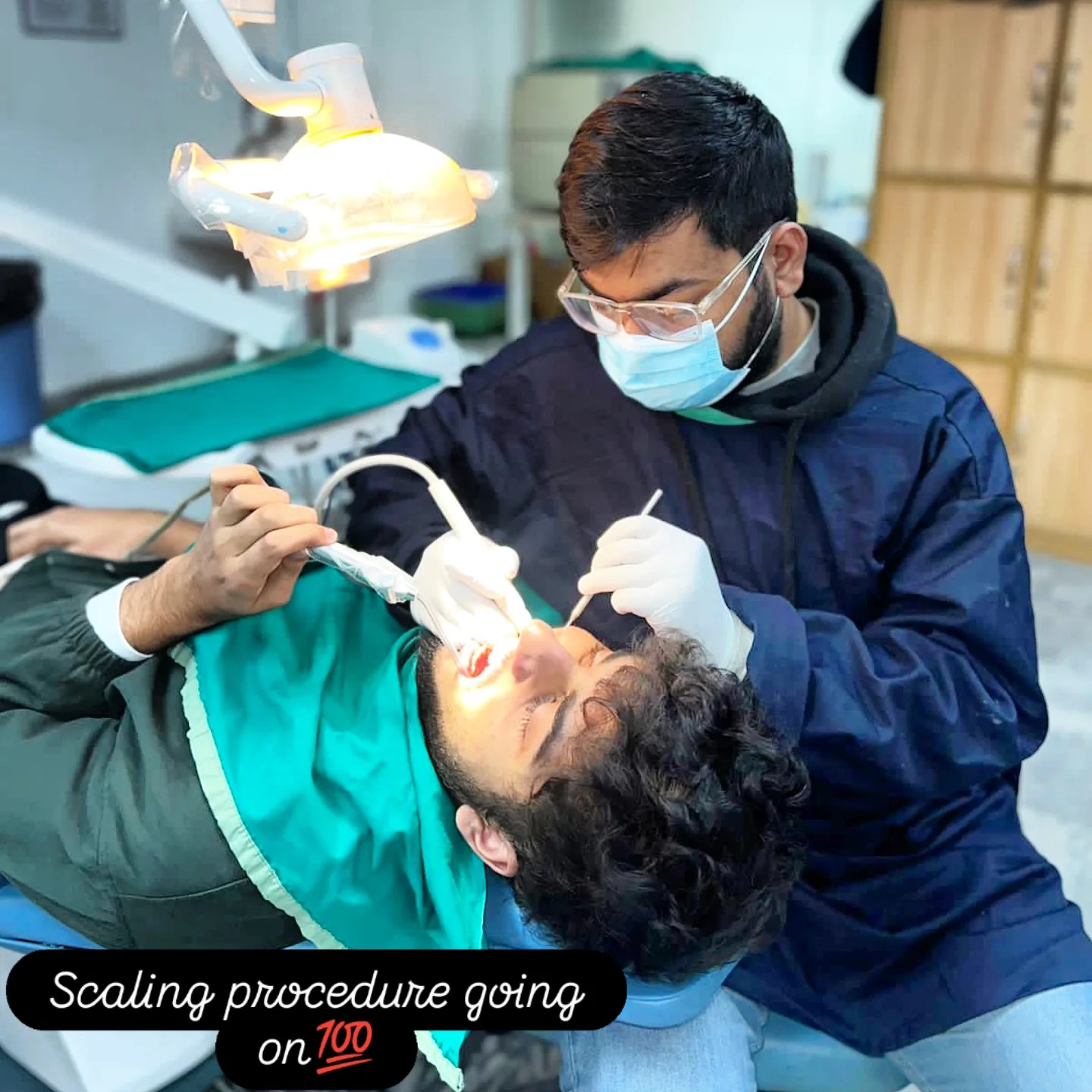
Dr. Mian Momin Ahmad
“Periodontitis at twenty-five is uncommon, and it is exactly the finding that stops most clinicians short for a moment. Most of the gum disease I treat is in patients in their forties or fifties — by which point the bone we are trying to save has often already gone. To catch a Stage II case at twenty-five is, in practical terms, a chance to halt the disease rather than just slow its decline. The conversation with younger periodontitis patients is direct: this is treatable, but the home care has to be real, every day, for the rest of your life. Mr. Subhan accepted that on day one. The deep scaling did the visible work; his routine at home is what is keeping it that way.”
Six daily habits that hold the result.
Periodontitis aftercare is more rigorous than routine aftercare. We do not pretend otherwise. These six habits are the entire deal — none of them are optional and none of them require buying anything expensive.
Soft brush + Bass technique, twice a day
Soft-bristled brush only. The Bass technique points the bristles down at the gum line at a forty-five degree angle and uses small jiggling motions — the bristles work into the very gap where his pockets sit. Hard scrubbing wears the gum away over years and exposes the root, which is yellower and more sensitive. We sized him up for a sensitive-bristle brush before he left and demonstrated the angle in the mirror.
Interdental brushes — twice a day, not once
For most patients we recommend interdental brushing once a day. For periodontitis patients, that is not enough. We sized Mr. Subhan up for the right TePe interdental brushes in clinic, asked him to use them after breakfast and after dinner, and walked through the technique on three different sites before he left. The space between teeth is exactly where his disease lives. Reaching it twice a day is not optional.
Chlorhexidine 0.12% rinse for 14 days, then plain water
Chlorhexidine is a strong antiseptic mouthwash. It calms the bacterial load while the gum tissue heals after the deep scaling. We asked him to use it twice a day for two weeks — and then to stop. Used long-term it stains the teeth and dulls taste; used for two weeks after deep scaling, it does exactly the job we need it to do. After day fourteen, plain water rinses are enough.
Watch for sustained bleeding for the first month
Some bleeding for three to five days after deep scaling is normal — the gum is healing. What is not normal is bleeding that is still happening at the same sites two weeks in. If he sees that, the instruction we gave him on day one is to message us on WhatsApp with a photograph and we will see him within forty-eight hours, no fee. Periodontitis is a disease that punishes silence. We told him the door is always open.
Three-month recall — not six
For a patient with healthy gums, six-monthly cleanings are the right cadence. For a periodontitis patient, that interval is too long — bacteria have time to repopulate the pocket before we get a chance to see it. Mr. Subhan's recall is three months, and it stays at three months for the foreseeable future. Each visit is a forty-five-minute supportive cleaning at PKR 4,500. We have his next two appointments on the calendar already.
No smoking — and we asked at intake
Smoking is the single biggest accelerator of periodontitis after plaque itself. We asked Mr. Subhan at the first visit. He does not smoke and never has, which is part of why his case at this age is unusual. We are noting it here for completeness — for any patient reading this who does smoke, the frank truth is that the deep scaling work above will not hold its result if the cigarettes continue. We have a separate cessation conversation for those patients.
The point isn't to panic. It is to act now.
Early gum disease at twenty-five is the kind of finding that catches people off guard, and that is exactly why it is worth taking seriously. You did not do anything dramatic to cause it. You will not have to do anything dramatic to control it. The fix at this stage is multi-quadrant scaling and a real home routine. The fix later is something else entirely.
What waiting another year or three or five actually does, in plain terms, based on the cases we see in this chair every week:
None of that is a scare tactic. It is the timeline we see, in this chair, every week. The fix at twenty-five is two visits and a real routine. The fix at thirty-five is rarely as simple. We would rather see you for the easy version.
More on gum disease, and the work behind it.
Three more patients like Mr. Subhan.
Every case in this archive is a real Odonto patient with their consent. Names are accurate where the patient was happy to share them, age ranges are real, and every photograph was taken in our Engineers Town clinic.
Worried about bleeding gums or sensitivity?
The first 15 minutes are free. We will examine your gums, take any photographs needed, and put a written quote in your hand. There is no pressure to book the cleaning the same day, and there are no hidden charges if you do.