How an 18-year-old Lahore student stopped his gums bleeding in one 45-minute visit
Mr. Irfan is in the second year of his bachelors at a Lahore university. For six months his gums had been bleeding every time he brushed, and he had quietly started avoiding the lower-front gum line because of it. His mother insisted he come in. He assumed it would be a long lecture about hygiene. It was not. This is the full story of the visit — what we found, what we did, what surprised him, and the small set of habit changes he walked out with.
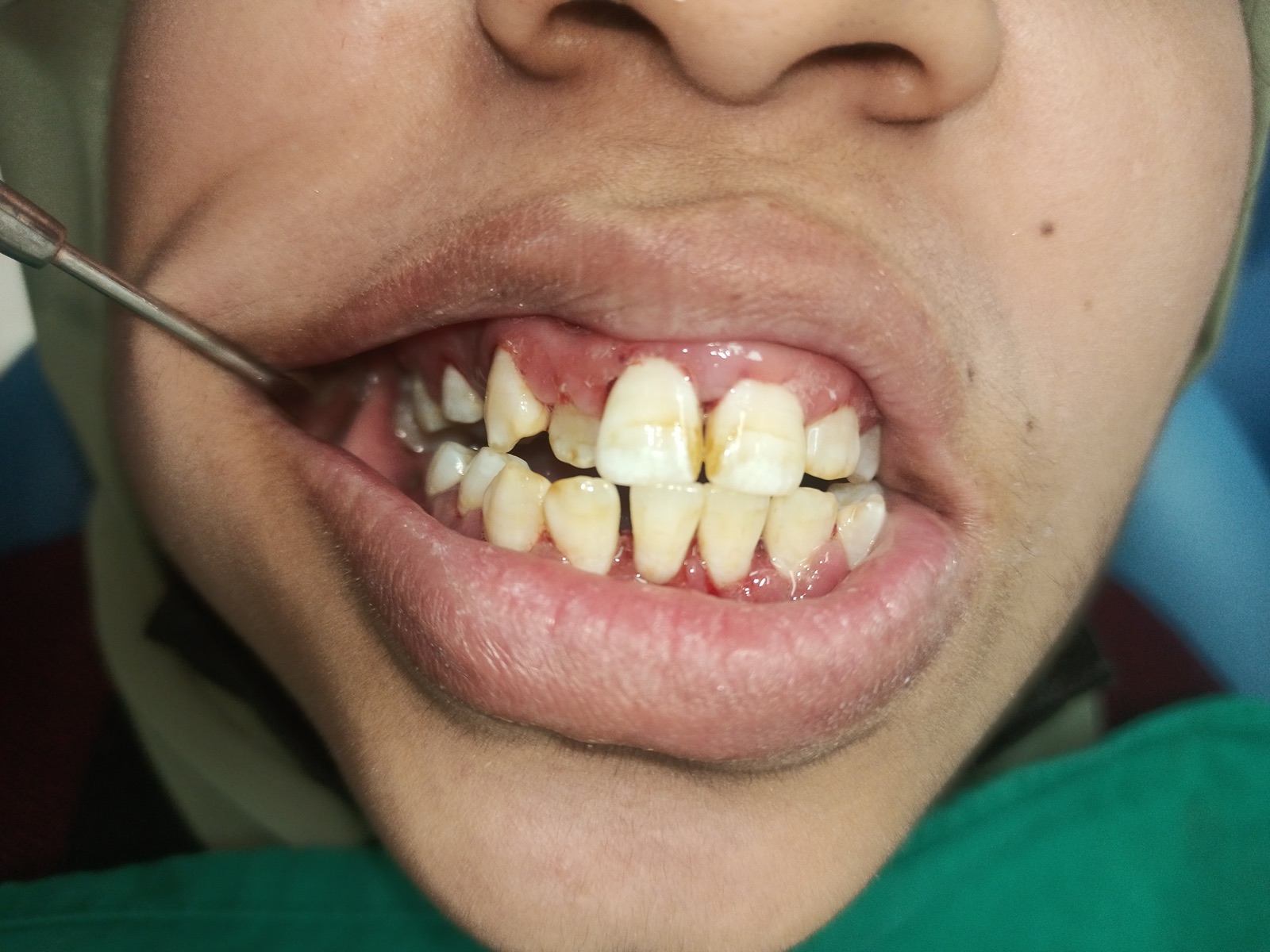
 Before
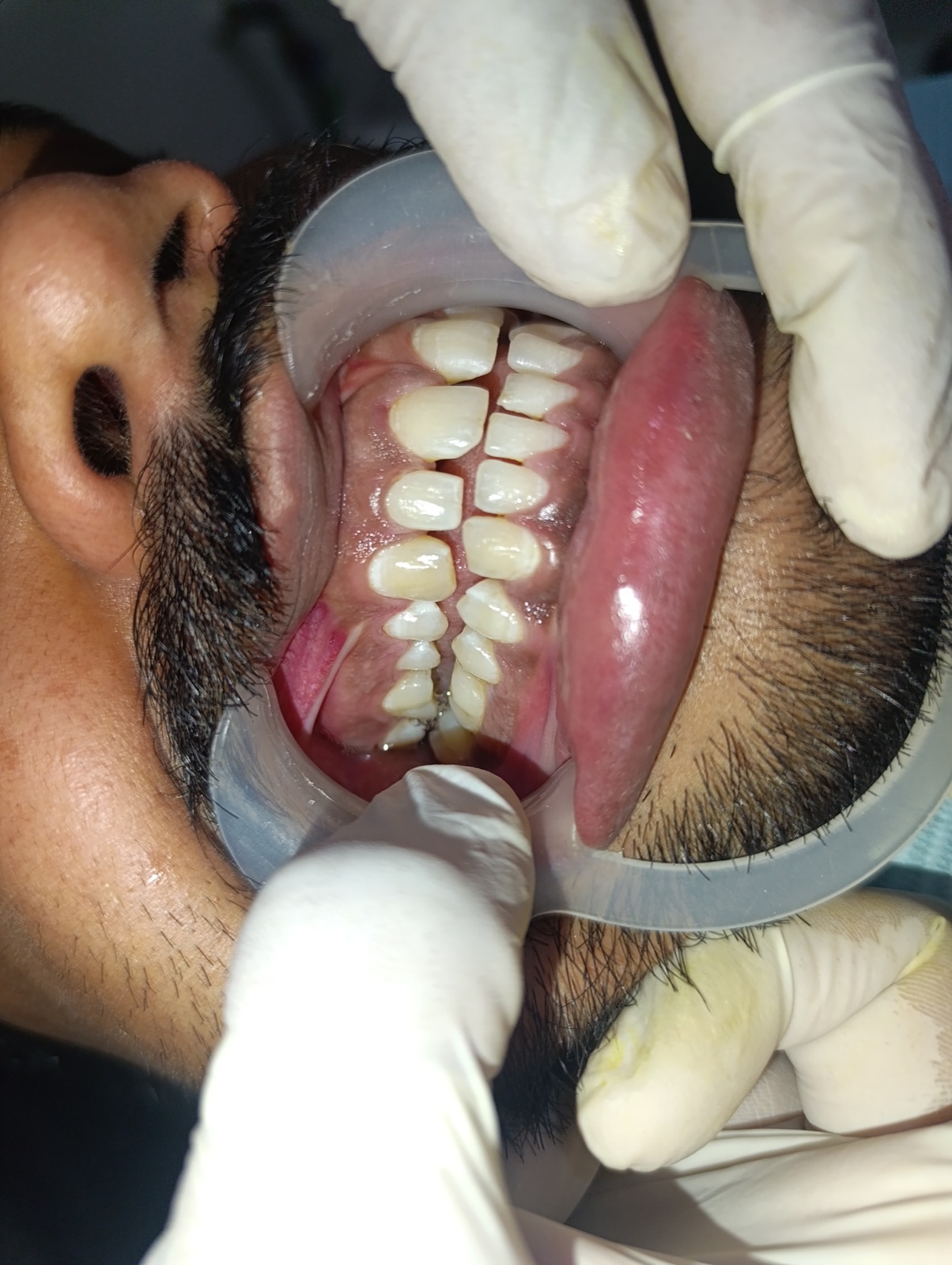 After
AfterThe bleeding had begun to embarrass him.
Most teenagers who walk into a dental clinic with bleeding gums are not sick. They are usually doing one or two small things wrong at home that have quietly compounded for two or three years. Mr. Irfan is one of them.
Mr. Irfan is eighteen and in the second year of his bachelors at a Lahore university. He brushes twice a day, like most people his age. He had not seen a dentist in six years — since a routine school visit when he was twelve. The last time someone had taught him how to brush was in primary school, with a poster on the classroom wall that he no longer remembers.
For the last six months, every morning the basin had been pink. Every evening, pinker. He had read on the internet that bleeding meant he was not brushing hard enough, and so for two years he had been brushing harder, with a hard-bristled brush from a Lahore local store, in long horizontal strokes — a routine that was, line for line, the opposite of what his gums needed. The bleeding he was scared of was, in large part, his own brush bullying his gum.
He had begun, quietly, to avoid the lower-front gum line altogether. On the days before a presentation he barely brushed those teeth at all, because every touch of the brush there produced a small spike of red in the spit. Plaque sat there longer because of that. Calculus formed faster because of that. The next time he did brush, the bleeding was worse. The cycle had been running for about eighteen months by the time he sat in our chair.
What finally brought him in was his mother. She had noticed a faint smell on his breath one evening at dinner and, as Pakistani mothers do, refused to let it go until he booked an appointment. He arrived bracing for a long lecture on hygiene. He had not brought anyone with him because he thought he would walk out feeling small.
The first appointment ran fifty minutes. We took five standardised intra-oral photographs. We charted pocket depths at six points around every tooth. Then we did something we do for every patient with this history: we asked him to brush, with the brush he had brought from home, in front of us. The horizontal scrub was visible at the first stroke. The hard bristles were visibly flattened on the heel of the brush from being driven too hard against the teeth.
We sat back and walked him through the good news first. No cavities. No bone loss. No deeper periodontal involvement. The tooth structure underneath the calculus was perfectly intact. Despite the dramatic look from outside — the inflamed margins, the bleeding at almost every probing site — what he had was a textbook case of generalised gingivitis, the early form of gum inflammation that is fully reversible in a single thorough cleaning at his age.
We told him this might be the easiest dental visit of his life. He looked sceptical. We made the appointment for the next afternoon, between his university lectures, and asked him to bring no toothbrush — we would be giving him a new one.
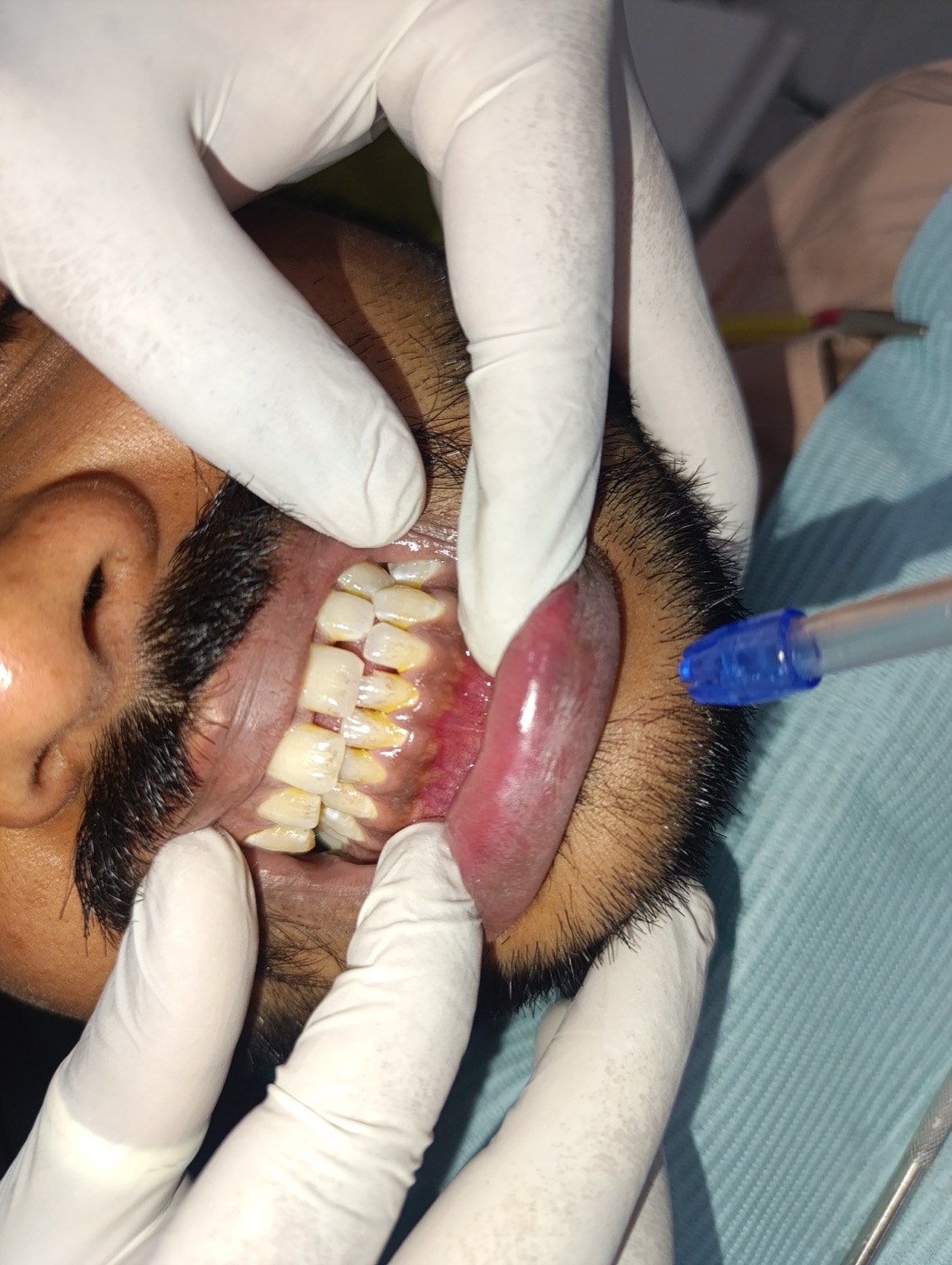
Four things — explained in plain English.
Most patients are nervous that something serious will be discovered. We always start with what we've ruled out, then walk through what we did find — without scary words and with a clear plan for each.
Bleeding gums in 5 of 6 areas
When we tested his gums at six points around every tooth, five of the six areas of his mouth bled within seconds. In a 40-year-old this can be worrying. In an 18-year-old it is almost always fully reversible. What we were looking at was generalised gingivitis — the early, mild form of gum inflammation, which is the gum reacting to plaque sitting along the tooth. The tissue is irritated, not damaged. Take the plaque away and clean up the technique behind it, and the gum settles inside a week. We see this exact picture in dozens of young patients every year and it almost never becomes anything serious — provided the visit happens at this age, not ten years later.
Heavy calculus around the gum line
Calculus — the hard, rough deposit you can sometimes see as a yellow or brown ring along the bottom of the tooth — had built up across both his lower-front teeth and the back molars. The reason it had built up was simple: his brushing was hitting the white, visible part of the tooth (the crown) but missing the cervical zone, which is the narrow band where the tooth meets the gum. That cervical band is where plaque parks, and within 48 hours plaque hardens into calculus that no toothbrush can lift off. This is what an ultrasonic scaler is for. Five minutes of cleaning lifts off two years of build-up.
Hard-bristled brush + scrubbing motion
This is the part of the case that surprised him the most. He had been brushing harder, longer, and with a stiffer brush than almost anyone we had seen in months — believing the whole time that this was the right thing to do. The brush was a hard-bristled supermarket brush from a Lahore local store, and the motion was a horizontal scrub. Both were causing trauma to his gum margin. The bleeding he had assumed meant he was not brushing enough was, in fact, partly the brush bullying the gum. We changed the brush before he left.
Spacing between front teeth
His upper-front teeth had natural mild spacing — small gaps between the incisors. This is purely cosmetic; it is not a disease and not something we needed to fix. We mention it here because spacing matters for one practical reason — food gets impacted in those gaps and sits there, which can speed up plaque build-up if the gap is not cleaned. So we issued him an interdental brush sized to the wider spaces and showed him how to slide it through in two seconds. The spacing itself stays. Just the food does not.
Four steps. All in one sitting.
Every step was explained before it happened. He could see what we were doing in a small mirror at any point. There was no rush.
A quick check-up
We took five standardised photographs of his teeth so we could compare the after-photos to the same angles. We measured the gums at six points around every tooth — that takes about three minutes. We turned the X-ray screen towards him and walked him through what we were seeing. Nothing was hidden. He could see exactly the same picture we were seeing.
~ 8 minNo anaesthesia needed
This is one of the calmer parts of being eighteen with this kind of case. There were no deep deposits, no surgical work, and no heavily inflamed sites that needed numbing. We offered a topical numbing gel on the lower-front teeth where the calculus was thickest; he chose not to use it because he wanted to feel what a clean instrument actually feels like at the gum line. No injections at any point.
~ 0 minCleaning, four corners
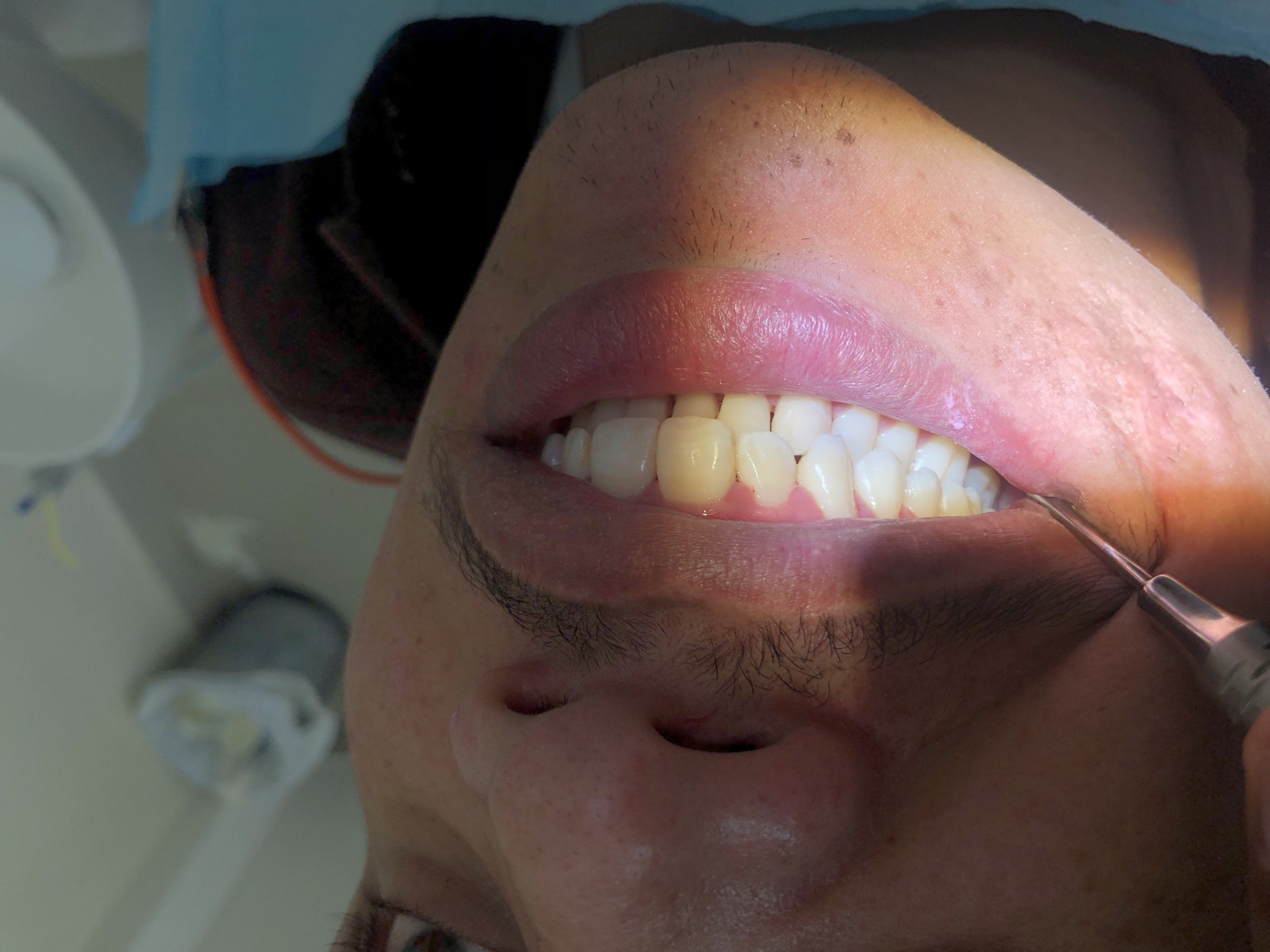
A small ultrasonic tip with a continuous water spray vibrates at a frequency that lifts calculus off in tiny layers. We work in the same order every time — upper right, upper left, lower left, lower right. Special attention along the gum line, because that is where his brushing had been missing for two years. The cervical bands lifted cleanly. The spacing between the front teeth needed slow, careful angulation so the proximal enamel was not scored. After fifteen minutes the visual difference was obvious to him in the small mirror we held up.
~ 25 minBrushing technique reset + soft brush + recall
A fine, low-abrasive paste applied with a slow rubber cup polished the enamel back to its natural shine. Then we sat down for twelve full minutes and changed the way he brushes. Modified Bass technique demonstrated on a model first, then mirrored back by him on himself. We sized him for a soft-bristled compact-head brush and gave it to him there and then. The hard brush stayed with us. Interdental brush demo for the wider gaps, floss for the tighter contacts. Six-month recall booked before he stood up.
~ 12 min During — ultrasonic
 After — final polish
Same patient. Same chair. Same day.
Drag the divider across the photo to compare. Both photos were taken with the same camera and lighting inside our Lahore clinic — "before" right as he sat down, "after" before he stood up.
BeforeAfterWhy a toothbrush cannot fix this alone.
Patients often ask, reasonably, why brushing twice a day for years did not prevent this from building up. The honest answer has three parts. None of them are your fault.
Plaque hardens into calculus in 24 to 48 hours
Plaque is the soft, sticky film of bacteria that forms on every tooth, every day. Brushing removes most of it. But anywhere your brush misses — usually right at the gum line, and especially behind the lower front teeth — saliva mineralises that plaque into calculus within one or two days. Calculus is rock-hard. Once it forms, no toothbrush in the world will remove it. That is what the ultrasonic scaler is for.
Bleeding is a signal, not a punishment
When the gum bleeds, it is not telling you to stop or to brush harder. It is telling you that the tissue at that exact spot is irritated by the plaque sitting there, and is trying to mount an inflammatory response. The fix is to remove the plaque and to keep removing it gently, every day, with the right brush and the right stroke. Within a week, the inflammation settles, and the same spot stops bleeding. The bleeding was the gum's way of asking for help, not a verdict on you.
The cervical band is where it all happens
The cervical band is the narrow zone where the white crown of the tooth meets the pink gum. This is where plaque parks fastest, where calculus forms first, and where most people's brushing fails. Mr. Irfan's brushing was hitting the crown but missing the band. Once we showed him how to angle the bristles forty-five degrees towards the gum line, the cervical band started getting cleaned for the first time in two years.
Five questions our patients always ask.
These are the worries we hear most often, in the words our patients use. Tap any one to read the long answer.
Will scaling weaken my teeth or make them more sensitive forever?+
This is the single most common worry we hear, and the honest answer is: no — but you may feel mildly sensitive for the first two to three days, and we want to explain why so it does not surprise you.
Calculus acts like an insulator over the tooth. When we remove it, the enamel underneath is exposed to cold air and cold drinks again, sometimes for the first time in two or three years. That sensation registers as sensitivity for 24 to 72 hours. Using a sensitive toothpaste like Sensodyne for one week handles it almost completely. After that, the sensitivity is gone — and the tooth is structurally stronger because the underlying surface is now clean and able to absorb fluoride from your toothpaste again.
For Mr. Irfan specifically, who is eighteen, the enamel underneath the calculus was completely intact and unworn. Once cleaned, it returned to a normal sensitivity baseline within four days. He is, in clinical terms, exactly the patient who recovers fastest.
I am only 18 — is this not something old people get?+
No. In fact this is exactly the age at which we want to see a patient with bleeding gums, because at 18 the disease is reversible in a single visit.
Gingivitis — the early form of gum inflammation that Mr. Irfan had — is something between a quarter and a third of teenagers in Pakistan have at any given moment, mostly because professional cleaning is rare in this age bracket and brushing technique is rarely taught properly at school or at home. The version we see at 18 is the easy version. It is the gum reacting to plaque, nothing deeper.
What changes with age is what gingivitis becomes if it is left to run. By the late twenties, untreated gingivitis in some patients quietly converts into early periodontitis — the deeper form, where the bone supporting the tooth begins to recede. By 35, that conversion is much harder to undo. The visit at 18 is straightforward. The visit at 28 is more involved. The visit at 38 is, for many patients, a multi-session protocol.
How painful is the scaling itself? Will I need an injection?+
For routine scaling — which is what Mr. Irfan had — most patients do not need any anaesthesia at all. The ultrasonic tip vibrates at a high frequency and runs cool water over the tooth at the same time. The sensation is best described as a buzzing or a tickle, and a slight pressure where the calculus is being lifted off.
Where patients sometimes feel a sharper sensation is at the gum line on the lower front teeth, because that area has the most concentrated nerve endings and is also where the heaviest calculus usually sits. For those specific areas we apply a topical numbing gel — a cotton bud, no injection — which dulls the sensation completely. We offered Mr. Irfan exactly this and he chose not to use it; he wanted to feel what a clean instrument feels like at the gum line, so he could compare it to what brushing should feel like at home.
Injections are reserved for patients with very deep deposits below the gum line. That applies to roughly one in twenty cases. None of our 18-year-old patients have ever needed one.
I was using a hard brush because I thought it cleaned better. Why was that wrong?+
This is a misconception we hear in this clinic three or four times every week. Almost every Pakistani household has been told, somewhere along the line, that a hard brush cleans better. It does not.
Plaque is soft. It is a sticky, slightly furry film of bacteria. A soft brush, used correctly, sweeps it off without effort. A hard brush does not lift the plaque any better — what it actually does is two extra things you do not want. It scrubs the gum margin until the gum recedes, and over years it sands the cervical part of the enamel until you can see the yellow root surface underneath. Both are irreversible. You cannot grow gum back, and you cannot grow enamel back.
Mr. Irfan had not yet developed visible recession — at 18 the gum is still resilient enough to take a few years of mistreatment. But the bleeding was the first warning sign that the trauma had begun. We changed the brush before he left, and we asked him not to go back. We will not have to ask him twice — within five days he could feel the difference himself.
How much does this cost? Are there hidden charges?+
A standard scaling and polishing at Odonto is PKR 4,500, all-inclusive. That covers the full chart, the X-rays if we need any, the scaling itself, the polish, and the printed aftercare sheet you take home.
There is no extra charge for the consultation, no charge for the photographs, and no charge for the topical anaesthetic gel if you ask for it. For Mr. Irfan, we also issued him the soft-bristled brush and the interdental brush at no extra cost — we keep a small stock of these to give to patients who need a switch immediately, because asking someone to leave the clinic and remember to buy a new brush often means the wrong brush stays in use for another three weeks.
Mr. Irfan paid PKR 4,500. There were no add-ons. His next six-monthly visit will be the same fee.
The follow-up visits.
One scaling is not the end of a case — it is the beginning of a maintenance cycle. Every patient at our clinic gets the same follow-up structure: a quick review at one week, a comparison at one month, and a full repeat appointment at six months. Here's how Mr. Irfan's went.
He came in for a ten-minute review at one week. Bleeding-on-probing had reduced from five sextants down to one — a single spot on the lower-right molar — which we showed him how to focus on with the interdental brush. He had not seen pink water on the brush since day three. The new soft brush was in daily use; the modified Bass technique was correctly executed when he demonstrated it back to us.
He messaged us on WhatsApp at the four-week mark. The hard brush had been retired without prompting. He had begun using the TePe interdental brush nightly through the front-tooth gaps. Plaque levels at a chairside check were dramatically down. He was not whitening at home — we had asked him to wait at least three months and he had listened.
He returned in October for the six-month recall. Photographic comparison filed against baseline. Minimal stain re-accumulation. No new gingival inflammation. The five photographs taken so we could compare against June. A short audit of brushing technique chairside — still correct. He paid PKR 4,500 again. We have his next visit on the calendar for April 2026.
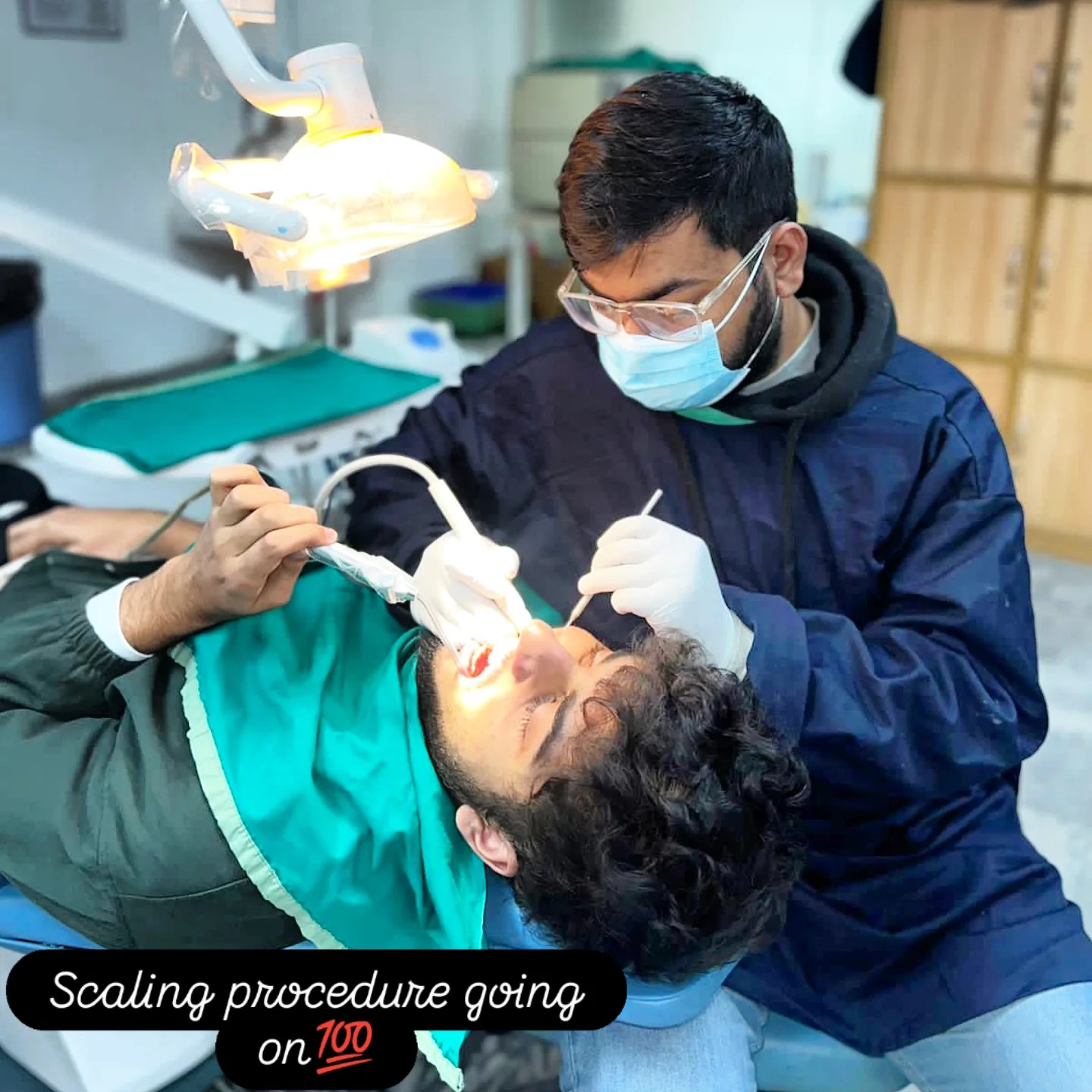
Dr. Mian Momin Ahmad
“Eighteen is the optimal age for the first proper hygiene re-education a patient will ever receive. At 18 the habits are still flexible and the gum tissue is still resilient enough to bounce back from two or three years of bad brushing. By 35 the habits are set, and gingivitis that was reversible at 18 has often quietly converted to early periodontitis — bone loss territory, multi-visit treatment territory. The visit at this age is straightforward. The visit ten years later is rarely as simple. Every parent who reads this case file: book your teenager. The clean is the easy part. The conversation about brushing is the actual treatment.”
Six small habits that hold the result.
A clean is not the end of the story. The teeth stay this way only if a few small things are done at home. These six are the only ones we asked Mr. Irfan to commit to — none of them require buying anything expensive, and we issued the brush and the interdental brush free with the appointment.
Soft-bristled brush — and stay on it
We gave him an Oral-B soft compact-head brush before he left the chair. The hard supermarket brush stayed with us. A soft brush bends slightly under pressure, so it cleans the cervical band without hurting the gum. A hard brush plows through and damages the tissue. He has been asked, plainly, not to go back to a hard brush — even if every advert and every uncle tells him the hard one cleans better. They are wrong. Soft is the answer for life.
Modified Bass technique — small circles at the gum line
The action that produces bleeding is horizontal scrubbing. The action that prevents bleeding is the modified Bass technique — bristles angled forty-five degrees towards the gum line, gentle vibration in tiny circles, then a sweep towards the chewing surface. We showed it to him on a model, then he mirrored it back to us in his own mouth. Two minutes total, twice a day. The motion looks slow on first try. After ten days it becomes the only way that feels right.
TePe interdental brush size 1 for the front gaps
The natural spaces between his upper-front teeth are too wide for floss to do meaningful work and too narrow to ignore. A TePe size 1 interdental brush slides through each gap in two seconds — once a day at night is enough. He stands at the bathroom mirror after dinner and works through the four anterior spaces. Total time per day: under thirty seconds. The single most useful thing he can do for the spacing is the brush, not whitening, not braces.
Salt-water rinse for the first 5 days
After the scaling, the gum line is briefly tender — a normal post-cleaning sensitivity that lasts two to three days. A salt-water rinse, half a teaspoon of salt in a cup of warm water, swished gently for thirty seconds twice a day for five days, settles the tissue and reduces any minor bleeding while the gum heals. It is also free, and most students already have salt at home. We do not push expensive mouthwash unless there is a specific reason.
Skip whitening toothpaste for now
Most "whitening" toothpastes are mildly abrasive — they work by sanding off the surface stain. Right after a professional scaling the enamel is at its smoothest, and using an abrasive paste at that point causes more harm than good. He was asked to use a regular fluoride toothpaste — Sensodyne Sensitive or Colgate Total — for the next three months. He is eighteen. His enamel is not what we want to wear down chasing a half-shade brighter that never holds.
Six-month recall — book it now
Calculus reforms slowly. For most patients, six months is the right interval — long enough that home care is meaningfully tested, short enough that nothing severe accumulates. His next visit is on our calendar for October 2025. Each follow-up clean takes 25 minutes, costs PKR 4,500, and we take the same five photographs so he can see his own trend year over year. The single highest-value habit a teenager can build is showing up for the six-month visit. The clinical work is the easy part of the appointment. The habit is the result.
The visit at 18 is much easier than the visit at 28.
We do not lecture about postponement. The reasons we hear from young patients are real — university schedules, hostel routines, embarrassment about the bleeding itself, and the assumption that a cleaning is going to be expensive or painful. None of those are stupid. They are why we keep walk-in slots most weekday afternoons specifically for students.
What waiting actually does, in plain terms — gingivitis at 18 is reversible in one visit; periodontitis at 30 is the disease we treat over months. The earlier the visit, the simpler the treatment. Always.
None of that is a scare tactic. It is the timeline we see, in our chair, in this clinic, every week. The fix at 18 is a single 45-minute visit and a softer brush. The fix in ten years is rarely as simple. If you are a parent reading this for your teenager, please book the visit while the gingivitis is still reversible.
More on scaling, and the conditions behind it.
Three more patients like Mr. Irfan.
Every case in this archive is a real Odonto patient with their consent. Names are accurate where the patient was happy to share them, age ranges are real, and every photograph was taken in our Engineers Town clinic.
Want a result like Mr. Irfan's?
The first 15 minutes are free. We will examine your teeth, take any photos needed, and put a written quote in your hand. There is no pressure to book the cleaning the same day, and there are no hidden charges if you do.